
Adding Supers to Primal Bee Hives


Here’s the big idea up front: adding supers is mostly about space management. If bees don’t have room, they’ll convert brood space into honey storage — or swarm. Your job isn’t to chase honey yields; it’s to stay slightly ahead of the bees.
Primal Bee supers work with the hive’s thermal system and standard Langstroth equipment, so nothing exotic is required. What does change is timing: thermally efficient colonies build faster, which means you’ll usually add supers earlier than you would on a wooden hive.
Compatibility (Short and Simple)
Primal Bee supers are intentionally boring — in a good way.
- Accept standard Langstroth frames (medium or deep)
- Work with wax or plastic foundation
- Compatible with standard extractors and uncapping tools
Thermally, the super doesn’t break the system:
- Sealed joints maintain the hive’s temperature control
- Insulated walls extend the thermal envelope upward
- Bees experience the super as part of the same stable cavity
You don’t need special equipment. You don’t need special frames. If you’ve extracted honey before, you already know how this part works.
When to Add a Super (This Matters More Than How)
Managing space is the beekeeper’s main job. if bees feel crowded, they’ll pull brood to make room for honey. If they run out of room entirely, they swarm.
The Real Signals to Watch
Add a super when you see most of the following:
- Bees covering 7–8 frames in the nest
- Bees actively working the top bars of the nest frames
- A strong nectar flow in your area (or consistent feeding)
- A solid, continuous brood pattern
If you wait until every frame is packed, you’re already late.
Seasonal Reality Check
- Spring: Add your first super earlier than you would on a wooden hive. Primal Bee colonies ramp up faster because they waste less energy on temperature control.
- Peak summer flow: Be prepared to add multiple supers quickly. Fast filling is normal.
- Fall: Remove empty or partially filled supers before winter. Honey for winter belongs in the nest, not overhead boxes.
Adding a Super: Step-by-Step
Before You Lift the Lid
Quick checklist:
- Colony strength supports expansion
- Nectar flow or feeding is active
- Nest is established and organized
- Your safety strap has enough slack for added height
If those boxes are checked, you’re good.
Installation Steps
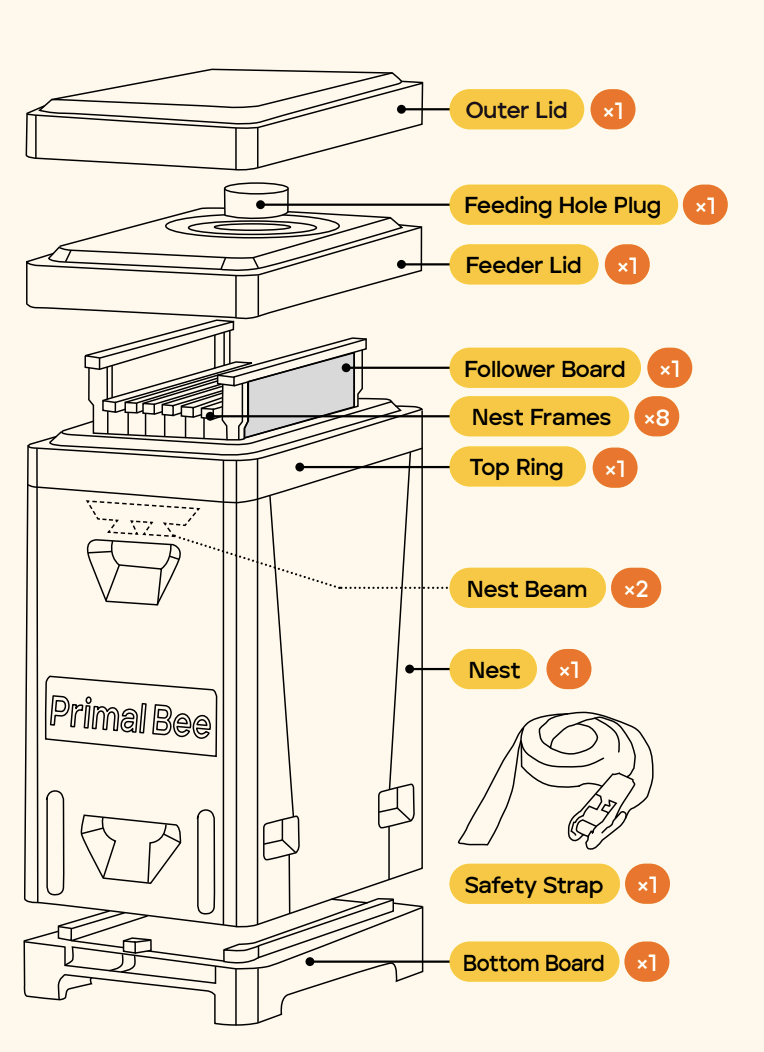
- Remove the outer lid and feeder lid
- Set them aside carefully — no need to rush.
- Place the super directly on the nest
Align it cleanly so seals sit flush. Thermal performance depends on good contact. - Add frames
Use standard spacing. Frames should hang straight and level. - Replace lids
Place the feeder lid on top of the super stack, then place the outer lid on top. Add a top ring if you're stacking more later. - Adjust the safety strap
Snug, not crushing. Recheck stability before walking away.
Managing Multiple Supers (Where People Get Tripped Up)
Always add new supers below partially filled ones.
Why? Bees naturally move upward with nectar. Putting an empty box on top often stalls progress. Sliding it underneath keeps traffic flowing and encourages full capping above.
Other practical notes:
- Check strap tension monthly during heavy flow
- Taller stacks may need better ventilation awareness
- Plan inspections with height in mind — stable footing matters
Monitoring Super Progress
Colonies in thermally efficient hives often:
- Fill supers faster than expected
- Cap honey more evenly
- Need shorter intervals between additions
Signs You’re On Track
- Nectar steadily accumulating
- Frames progressing toward capping
- Active bee traffic into the super
Time for Another Super?
- Frames filling rapidly
- Bees crowding the upper box
- Nectar flow still strong
When to Pull Supers
- ~80% capped is a good extraction target
- End of major nectar flow
- Before configuring for winter
Extraction: Nothing Fancy Required
Primal Bee super frames:
- Spin in standard radial or tangential extractors
- Uncap with regular knives or heated tools
- Handle just like conventional Langstroth frames
One tip: return wet frames promptly. Keeping the thermal envelope intact helps bees clean and reuse them efficiently.
Seasonal Super Strategy
Spring:
- Add early
- Expect fast buildup
- Stay ahead of space needs
Summer:
- Maintain continuous super space
- Extract before congestion becomes a problem
Fall:
- Remove unused supers
- Confirm adequate nest stores
- Reduce hive height for winter stability
Troubleshooting Common Super Issues
Bees ignore the super
- Colony may not be strong enough yet
- No active nectar flow
- Super misaligned or poorly sealed
Slow filling
- Focus on building population first
- Temporarily remove excess space if needed
Overcrowding or swarm signs
- Add space immediately
- Don’t wait for “one more inspection”
- Ventilation and spacing both matter
Key Takeaways
Primal Bee’s thermal efficiency means bees build faster — and that changes your timing, not your tools. Add supers early, manage space deliberately, and don’t wait for perfection.
If you do that, the bees will handle the rest — and they’ll usually reward you with fuller supers, steadier colonies, and fewer surprises.
On this Page
- Compatibility (Short and Simple)
- When to Add a Super (This Matters More Than How)
- Adding a Super: Step-by-Step
- Managing Multiple Supers (Where People Get Tripped Up)
- Monitoring Super Progress
- Extraction: Nothing Fancy Required
- Seasonal Super Strategy
- Troubleshooting Common Super Issues
- Key Takeaways


