It's April. Your bees may have already made their move.
Right now, your overwintered colonies are deep into spring buildup. Nighttime temperatures have been above 50°F for weeks. Pollen is flowing. Populations are exploding. And if your bees have outgrown the space you've given them, they're either preparing to leave or they're already gone.
Colony reproduction doesn't mean more eggs. It means swarming - half your bees leaving with the old queen while the other half stays behind to raise a new one.
For the bees, this is a success story.
For you, it's a disaster.
You just lost half your workforce heading into honey flow season. Your remaining colony needs weeks to raise and mate a new queen before it can rebuild. By the time it recovers, your neighbor's unswarmed hive has a serious head start on honey production.
Every spring, beekeeping forums fill up with the same desperate posts: "My bees swarmed. What did I do wrong?"
Usually the answer is: nothing.
You just didn't understand why they left. And if yours haven't swarmed yet, you still have time to prevent it, if you act fast.
Why bees swarm in spring (and what actually triggers it)
Most swarm prevention advice starts with "look for queen cells." That's like treating a fever without asking what's causing the infection.
Colonies swarm for predictable, biological reasons. Jason Graham, PhD in Entomology and Primal Bee's Head of US Operations, puts it bluntly from his work at the University of Florida Honey Bee Research and Extension Laboratory: bees want to swarm. It's how a colony reproduces at the superorganism level. More swarms means more evolutionary success. You're not going to talk them out of it.
Three conditions drive the decision.
The colony runs out of space. When the queen has nowhere left to lay, the workers start building queen cells at the bottom of the frames — that's the signal they're preparing to send half the colony out the door with a new queen.
The colony gets congested. Too many bees in too little space creates a traffic jam. Foragers can't get in and out efficiently. Nurse bees crowd the brood nest. The whole operation bogs down.
The queen's pheromone signal weakens. In a crowded hive, her pheromones can't reach every bee. Workers on the periphery stop getting the chemical message that says "queen is here, all is well." They start building replacement queen cells.
All three conditions share a root cause: the hive can't support the colony's growth.
Queen cells vs. swarm cells: how to tell the difference
This is where most beekeepers get confused, and it matters because the two types of cells tell very different stories.
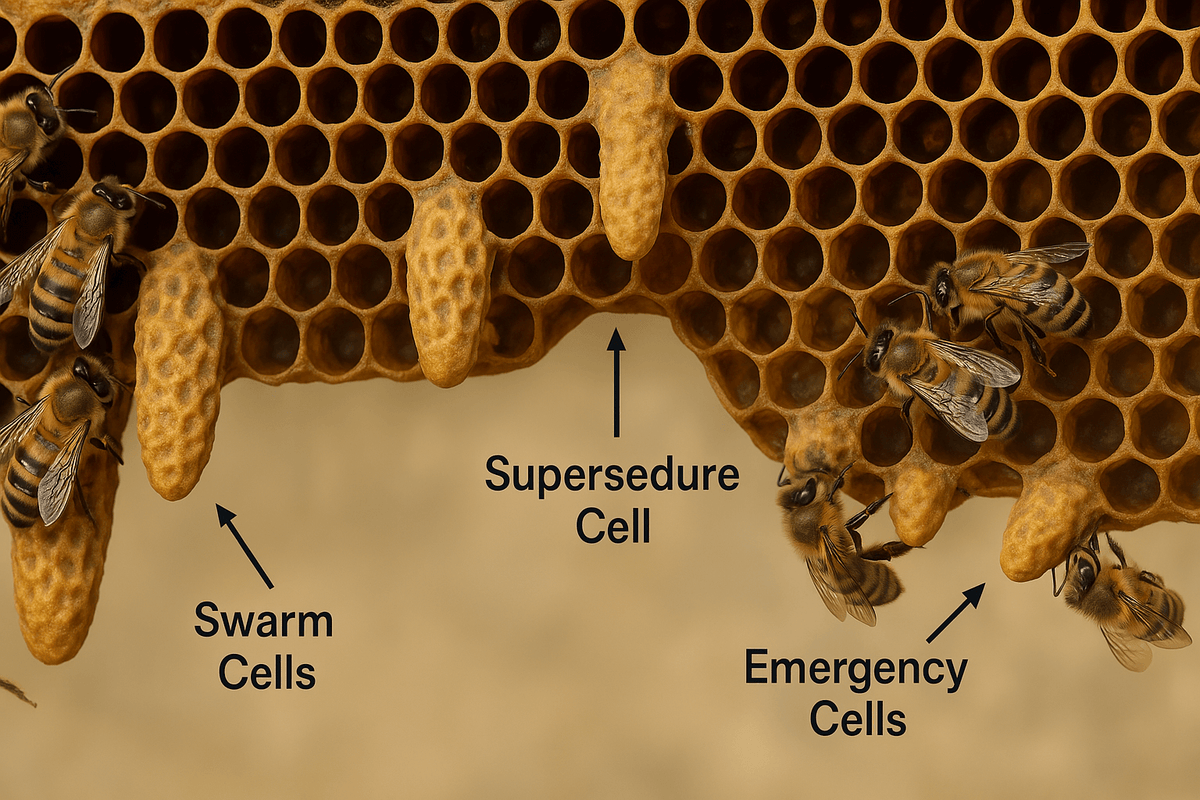
Swarm cells hang off the bottom of the frame. Dr. Graham explains that these are the reproduction signal — the hive is strong, running out of room, and making a second queen to send out with a swarm. Finding cells at the bottom means the colony is healthy but has outgrown its space. That's a management problem, not a health problem. (For a deeper dive, see our swarm control guide.)
Emergency queen cells show up in the middle of the comb face. These tell you something different entirely: the colony either doesn't have a queen, or has a weak queen the workers are trying to replace. They take one of the existing eggs and feed the larva royal jelly instead of switching it to pollen and nectar after three days. If you see queen cells scattered across the middle of your frames, that's a red flag about queen health — not a space issue.
Then there are the duds. Colonies sometimes build random queen cells with nothing inside — no eggs, no larvae, just wax structures that look alarming but mean nothing. Sometimes bees just build things. Dr. Graham has seen beekeepers panic over what amounts to bee doodling.
Knowing the difference determines whether you need to add space, requeen, or just close the hive and stop worrying.
Why standard Langstroth hives make swarming worse
Here's where hive design enters the equation.
A standard double-deep Langstroth gives you roughly 20 deep frames across two boxes for the brood nest. That sounds like plenty of space until you consider what swarm prevention actually requires: you need to pull apart both boxes, inspect all 20+ frames for queen cells, assess congestion, evaluate the queen's laying pattern, and check for space — on every inspection.
That's a lot of disruption to a colony that's trying to build up for honey season. Every time you open the hive, internal temperature drops. Bees abandon foraging to cluster and reheat the brood nest. Recovery takes 30-60 minutes in uninsulated wooden boxes. And the physical work isn't trivial either — you're unstacking heavy boxes, pulling frames one at a time from deep within stacked deeps.
So you're caught in a loop: the inspection you're doing to prevent swarming is itself stressing the colony and disrupting the buildup you need for a productive season.
Standard hives swarm once the colony fills 5-9 standard nest frames with brood — a relatively small colony by natural standards. The disconnected frame layout, split across multiple boxes, limits the queen's ability to lay in a continuous pattern. She's constantly navigating gaps between boxes, queen excluders, and fragmented comb surfaces.
How hive design affects swarm prevention
The Primal Bee nest chamber provides the equivalent volume of three Langstroth deeps, but consolidated onto 8 oversized continuous frames. The queen gets a massive, uninterrupted laying surface rather than navigating between disconnected boxes.
A Primal Bee colony doesn't reach swarming pressure until 7-8 nest frames are fully developed with brood — equivalent to 14-16 standard Langstroth frames — and bee population has already expanded into the super. Colonies reach substantially larger populations before they even consider swarming.
For swarm cell checks, you're inspecting 8 frames instead of 24. Inspections happen one frame at a time, at waist height — no unstacking heavy boxes. Primal Bee nest frames weigh about 2–3 kg (4–6 lbs) full of brood, making them manageable for a quick check. With the vertical brood design, cells hanging off the bottom are easier to spot than when they're buried between stacked boxes. And when you do open a Primal Bee hive, it rebounds to ideal temperature and humidity faster than a wooden hive thanks to the thermal efficiency of the EPS walls.
Standard Langstroth beekeeping requires constantly adding boxes and dismantling the nest to monitor growth. In the Primal Bee system, the nest architecture gives the queen enough room that swarm cell formation becomes far less likely in the first place.
Spring colony buildup: when to inspect and what to look for
Spring management isn't about following a schedule. It's about reading what your colony is telling you. (Our early spring management guide covers this in full detail.)
If you haven't done your first full inspection yet, now's the time — most regions are well past the nighttime-above-50°F threshold by April. Choose a warm, calm day with daytime temps above 60°F, mid-morning to afternoon. No wind. No heavy overcast.
Before you go in, start from the outside. Watch flight activity. Look at entrance traffic. Listen to the colony. Observe whether bees are bringing in pollen (a strong sign the queen is laying and the colony is building up). You can learn a tremendous amount without ever lifting the cover, and external checks carry zero energy cost to the colony. Only go inside if you have a specific reason.
When you do open up, use the established temperature framework: below 5°C (41°F), don't open the nest — peek through the feeding hole or listen. Between 5–18°C (41–64°F), you can quickly lift the cover to check expansion on top of the frames. Above 18°C (64°F), you can do a full inspection of brood expansion. (Timing varies by region — see our regional climate adaptations guide for specifics.)
Your first spring checklist: check for Nosema and treat if needed. Begin feeding to stimulate brood production — use heavy syrup (4:1 sugar to water by weight, or 80% sugar / 20% water) for wax production and general feeding. Continue feeding until natural nectar flow begins.
Look for population size, queen activity (fresh eggs and young larvae as evidence she's been active recently — you don't need to find her every time), brood pattern quality (continuous spiral = healthy queen; scattered, spotty eggs = problem), food stores, and signs of pests or disease. Also check the Varroa tray — if you find 30 or more mites over a 3-day natural drop check, that's a sign you need to start treatment.
For strong colonies, be ready to add supers early. Monitor for congestion. If the nest is fully developed and bees are already in the supers, the colony may need to be split.
For moderate colonies, gradually add frames as the colony grows. A good rule of thumb: when bees have drawn out and filled about 70-100% of the available frames, give them more. Stay ahead of growth without overexpanding.
For weak colonies, consider combining two weak colonies into one strong one. Requeening may be necessary if the laying pattern is poor. Feed more heavily until natural nectar flow begins. One red flag to watch for: if you see lots of drone brood (domed, bullet-shaped caps) without much worker brood, the colony may have laying workers — a sign the queen has been gone for a while. Workers can lay eggs that only become drones, and at that point combining with a queenright colony is usually the best path forward.
Managing space is really the beekeeper's main job. If bees have too little space, they fill it up and decide to send half the colony elsewhere. But give them too much space at once and you get wax moths and small hive beetles moving into areas without enough bees to patrol. The key is gradual expansion — always slightly ahead of growth, never massively ahead of it.
How to split a hive: turning swarm pressure into colony growth
If your colony is strong enough to swarm, it's strong enough to split. Rather than losing half your bees to a swarm you can't control, you make a managed split and end up with two productive colonies instead of one weakened one.
The colony is ready when the nest has 7-8 frames fully developed with brood and bees are already filling the supers. Or when the colony has 4-6 frames with brood, the first nectar flow has ended, and another is coming — splitting at the end of the first blossom gives the new colony time to build up.
Move 2-3 nest frames with eggs or very young larvae (1-3 days old) into a second nest box. The nurse bees will realize they're queenless and start raising a new queen from those eggs. Or provide a purchased queen if you want faster establishment.
One thing worth noting about queen rearing in Primal Bee hives: because temperature stays more uniform during the incubation period, a natural competitive process happens among queen cells. The healthiest queen prevails. Standard hives with temperature gradients between boxes don't support this selection process the same way.
Spring swarm prevention checklist
If you haven't done a full inspection yet this spring, get in there — April temperatures support it in most regions. Start from the outside first: watch flight activity, check for pollen loads coming in, listen to the colony. Then open up when it's above 18°C / 64°F.
Your spring priorities, in order: check for Nosema and treat if needed. Resume feeding with heavy syrup (4:1) to stimulate brood production and wax drawing. Add supers when the colony needs more space. Then assess for swarm risk.
Think in growth milestones, not schedules. You're adding frames until the nest fills up, then adding supers until those fill up. When bees have built out 70-100% of the frames you've given them, give them more room. When the nest is fully developed and bees are in the supers, it's time to either add more supers or plan a split.
Swarm cells at the bottom of frames mean they need space or a split. Queen cells in the middle of the comb mean a queen problem. If you notice a traffic jam of bees at the entrance, remove the entrance reducers — the colony has outgrown the reduced opening.
The best swarm prevention isn't constant vigilance. It's a hive system that gives the queen room to lay, the colony room to grow, and the beekeeper fewer reasons to open the box in the first place.