
How Much Does a Beehive Cost? 2026 Price Breakdown
What a beehive really costs in 2026 — kit, bees, tools, and yearly upkeep — plus how insulated hives cut maintenance and pay for themselves faster.
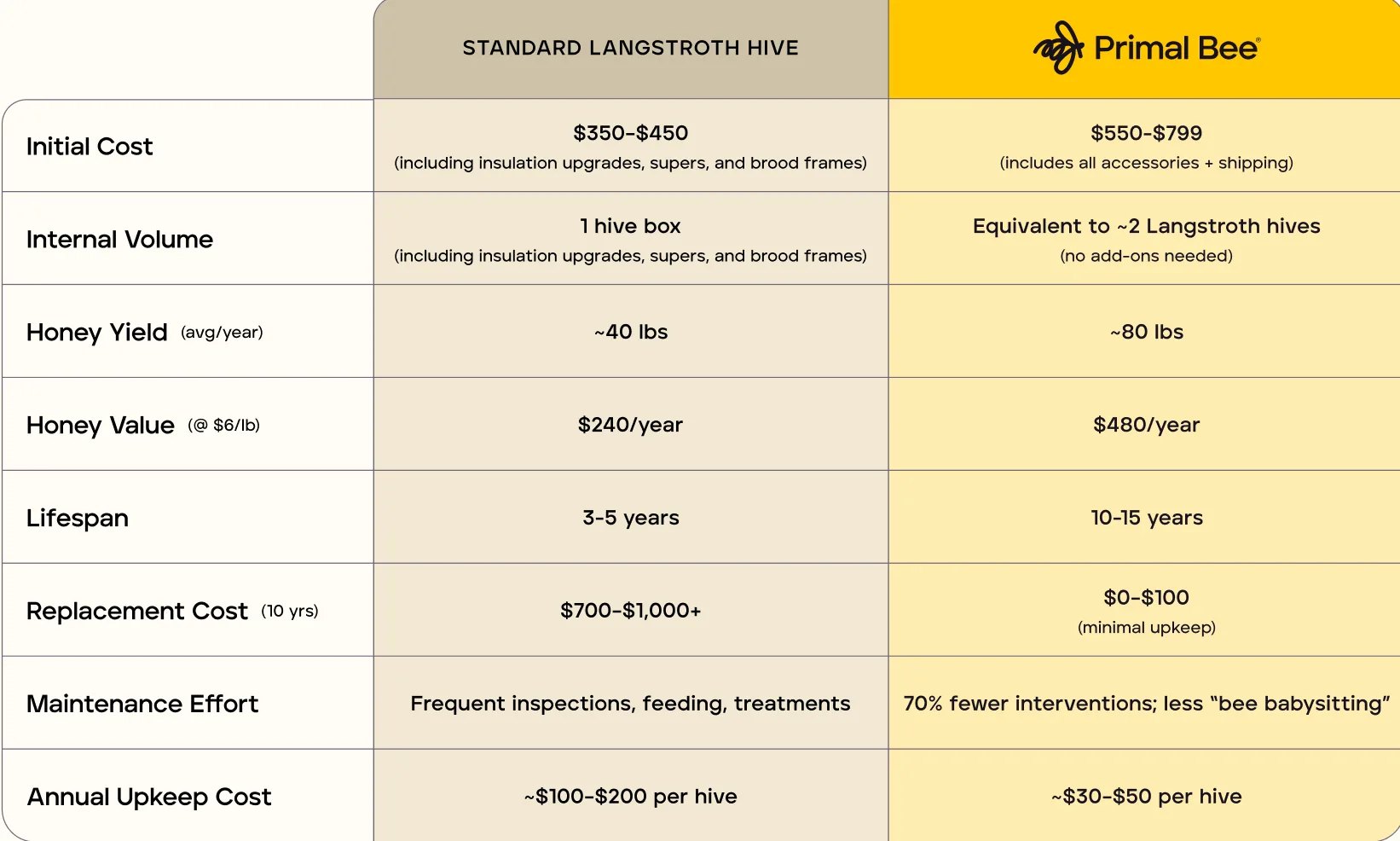
The first question every beekeeper asks
“How much does a beehive cost?” It’s the very first question most people ask — and also the most misleading.
Yes, you can find a kit online for $200. You can also spend $800–$900 on a premium hive. But price tags don’t tell you the total cost of ownership.
The real answer depends on what you value:
Do you want the cheapest entry point?
Or do you want the most efficient system that pays for itself over time?
Startup costs you can actually expect
Here’s what a first-year beekeeper will typically spend (U.S. 2026 prices, verified against major suppliers and customer field data):
| Component | Cost Range |
|---|---|
| Hive system | $225 (budget kit) → $900+ (engineered system) |
| Bee package (3 lbs + mated queen) | $140–$200 |
| Basic tools & smoker | $100–$150 |
| Protective gear | $100–$200 |
| Operating (feed, winter prep, treatments) | $50 → $400+ |
| Total Year 1 | $750–$1,500 |
Source: Dadant, Mann Lake, BeeBuilt, Flow Hive, and Primal Bee customer purchase data
That’s the baseline. The difference is what happens after Year 1.
Price categories in 2026
Budget Hives ($200–$300)
- DIY Langstroth box kits ($225–$250 unassembled)
- Basic starter packages from major suppliers
- Require painting, assembly, and usually heavy winter wrapping
Reality check: Lowest upfront cost, highest energy loss. Expect larger ongoing feeding bills and higher winter losses.
Mid-Range ($300–$600)
- Pre-assembled 10-frame Langstroths ($350–$450)
- Better construction, but still thin-walled wooden boxes
Reality check: More durable than budget kits, but energy performance isn’t significantly better.
Premium ($600–$1,200)
- Flow Hive: $779–$929 — designed for harvest convenience
- HiveIQ insulated hives: Dealer pricing required — EPS construction with claimed R-7.9 efficiency
- Apimaye insulated systems: $400–$620 — double-walled plastic with claimed R-6.93 efficiency
- Primal Bee thermodynamic hive: $799 — engineered thermodynamic design, sold as a complete beehive starter kit
Reality check: Higher upfront cost with different efficiency approaches.
The hidden variable: winter losses
Every beekeeper budgets for woodenware and bees. Fewer calculate the cost of winter losses.
In 2024–2025, U.S. beekeepers reported nearly 60% winter losses, the highest since tracking began.
Why so high? Thin-walled hives bleed heat. Colonies burn energy trying to keep brood at 35–36°C. That energy comes from stored honey (or your supplemental feed).
In one controlled winter-stores comparison, a standard hive consumed approximately 66 lb (30 kg) while Primal Bee consumed approximately 13 lb (6 kg) under comparable conditions. The result measures stores consumed in that comparison; it is not a universal feeding requirement or guaranteed reduction.
Verified performance: what independent testing shows
Swiss Field Comparison (2017)
In 2017 we ran a field comparison with Swiss Cantonal Inspector participation: two groups of ten hives, Primal Bee and standard Dadant, under the same protocol.
- Average emerging bees per hive: about 76,000 in Primal Bee vs. about 43,000 in Dadant (U.S. Patent 11,375,697, Fig. 20)
Multi-Climate Field Testing
Primal Bee field trials across 20+ locations and climates confirm what physics predicts:
- A whole-hive R-50+ average, compared with about R-1 for a 3/4-inch wooden wall
- Tested climates: Swiss Alps (-20°C) to Israeli deserts (45°C)
Cost scenarios: budget vs. engineered
Scenario 1: budget Langstroth ($250)
| Year 1 costs | Amount |
|---|---|
| Hive | $250 |
| Bees | $160 |
| Feed + winter wraps | $200 |
| Replacement due to losses | $200+ |
| Year 1 true cost | $810 |
| 3-Year cost (40% losses) | $2,400+ |
Hidden costs: Emergency feedings, frequent inspections, winter preparation materials, colony replacements
Scenario 2: Primal Bee thermodynamic ($799)
| Year 1 costs | Amount |
|---|---|
| Hive | $799 |
| Bees | $160 |
| Feed + treatments | $75 |
| Loss replacement | negligible |
| Year 1 true cost | ~$1,050 |
| 3-Year cost | ~$1,200–$1,400 |
Cost advantages: Minimal feeding requirements, up to 70% fewer inspections reported, reduced winter preparation needs, higher survival rates
The math: By Year 2, the “expensive” hive costs less. By Year 3, it isn’t close.
Real competitor analysis
Dadant & Mann Lake (dadant.com, mannlakeltd.com)
- Pros: Affordable, widely available parts, proven traditional design
- Cons: Standard wood construction (R-value ~1.2)
- Price range: $200-$450 for complete setups
- Best for: Traditional beekeepers comfortable with standard maintenance
Flow Hive (honeyflow.com)
- Pros: Innovative honey extraction system, reduces harvest disruption
- Cons: Standard wood thermal profile, premium price for convenience feature
- Price range: $779-$929
- Best for: Beekeepers prioritizing harvest experience
HiveIQ (hiveiq.com)
- Pros: EPS insulated construction, claims R-7.9 thermal efficiency
- Cons: Requires dealer contact for pricing, assembly required
- Price range: Dealer pricing (typically $400-$700 range)
- Best for: Beekeepers seeking insulated upgrade over wood
Apimaye (apimaye-usa.com)
- Pros: Double-walled insulated plastic, claims R-6.93 efficiency, award-winning design
- Cons: Higher cost than traditional, plastic construction preference
- Price range: $400-$620
- Best for: Hot climate beekeepers wanting insulated system
Hive Hugger (hivehugger.com)
- Pros: Retrofit external insulation, works with existing wooden hives, award-winning
- Cons: Seasonal application/removal, additional management step
- Price range: $102-$119 for wrap systems
- Best for: Beekeepers wanting to upgrade existing equipment
Primal Bee
- Pros: Patented whole-hive thermal design; up to 70% fewer inspections reported by hobbyist and sideliner beekeepers
- Cons: Higher upfront investment, newer market presence
- Price range: $799
- Best for: Performance-focused beekeepers seeking long-term efficiency
Advanced features comparison
| Feature | Standard wood | Flow Hive | HiveIQ | Apimaye | Hive Hugger | Primal Bee |
|---|---|---|---|---|---|---|
| Price range | $200-$450 | $779-$929 | Dealer pricing | $400-$620 | $102-$119 | $799 |
| Construction | Traditional wood | Wood + plastic frames | EPS insulated | Double-wall plastic | External wraps | Thermodynamic EPS |
| Thermal Claims | Standard | Standard | R-7.9 | R-6.93 | R-32 crown, R-6.9-8 wraps | R-50+ |
| Main Feature | Affordability | Easy extraction | Insulation | Insulation + durability | Retrofit insulation | Thermal efficiency |
| Assembly Required | Usually | Yes | Yes | Minimal | DIY installation | Minimal/DIY |
Making the investment decision
For budget-conscious beekeepers
- Consider total 3-year cost, not just initial price
- Factor in replacement colony costs (40% winter loss rate averages $160+ per replacement)
- Budget for ongoing feeding ($80-200 annually) and treatment expenses ($40-80 annually)
- Calculate time investment
For performance-focused operations
- Compare thermal efficiency claims across HiveIQ (R-7.9), Apimaye (R-6.93), and Hive Hugger (R-32 crown) options
- Calculate total cost including ongoing maintenance requirements and inspection time
- Factor in climate resilience for extreme weather conditions (tested from -20°C to 45°C)
- Consider labor savings: up to 70% fewer inspections reported
For commercial applications
- Analyze per-hive profitability over multiple seasons
- Evaluate labor cost reductions at scale (fewer emergency interventions)
- Consider competitive advantages of higher survival rates and reduced winter losses
- Factor in equipment longevity and replacement cycle costs
Key takeaways
- First-year costs for beekeeping run $750–$1,500 across all equipment categories
- Budget hives look cheaper, but operating costs add up quickly — winter losses and feeding expenses compound annually
- Premium convenience features (like Flow Hive) add functionality, not necessarily efficiency — harvest convenience vs. thermal performance are different value propositions
- Multiple insulated options exist with different thermal claims: HiveIQ (R-7.9), Apimaye (R-6.93), Hive Hugger (R-32), Primal Bee (R-50+)
- Success in beekeeping isn’t about the cheapest hive — it’s about the hive that actually keeps bees alive, thriving, and productive
Beekeeping isn’t cheap — but it doesn’t have to be wasteful. A hive that burns energy is a hive that burns your wallet.
The real question isn’t “How much does a hive cost?”
It’s “What’s the cost of keeping bees alive and productive?”
Related from Primal Bee: Run the numbers on your own setup with the beehive ROI calculator, compare the complete Primal Bee hive starter kit, or choose the right Primal Bee configuration. You can also read the head-to-head breakdowns — Primal Bee vs Flow Hive and Primal Bee vs Apimaye — or see the best insulated beehive guide.