The proof behind Primal Bee

Every number we use, where it comes from, and how it was measured. Some results come from lab tests, some from field trials and some from beekeepers. We label each one so you know which is which.

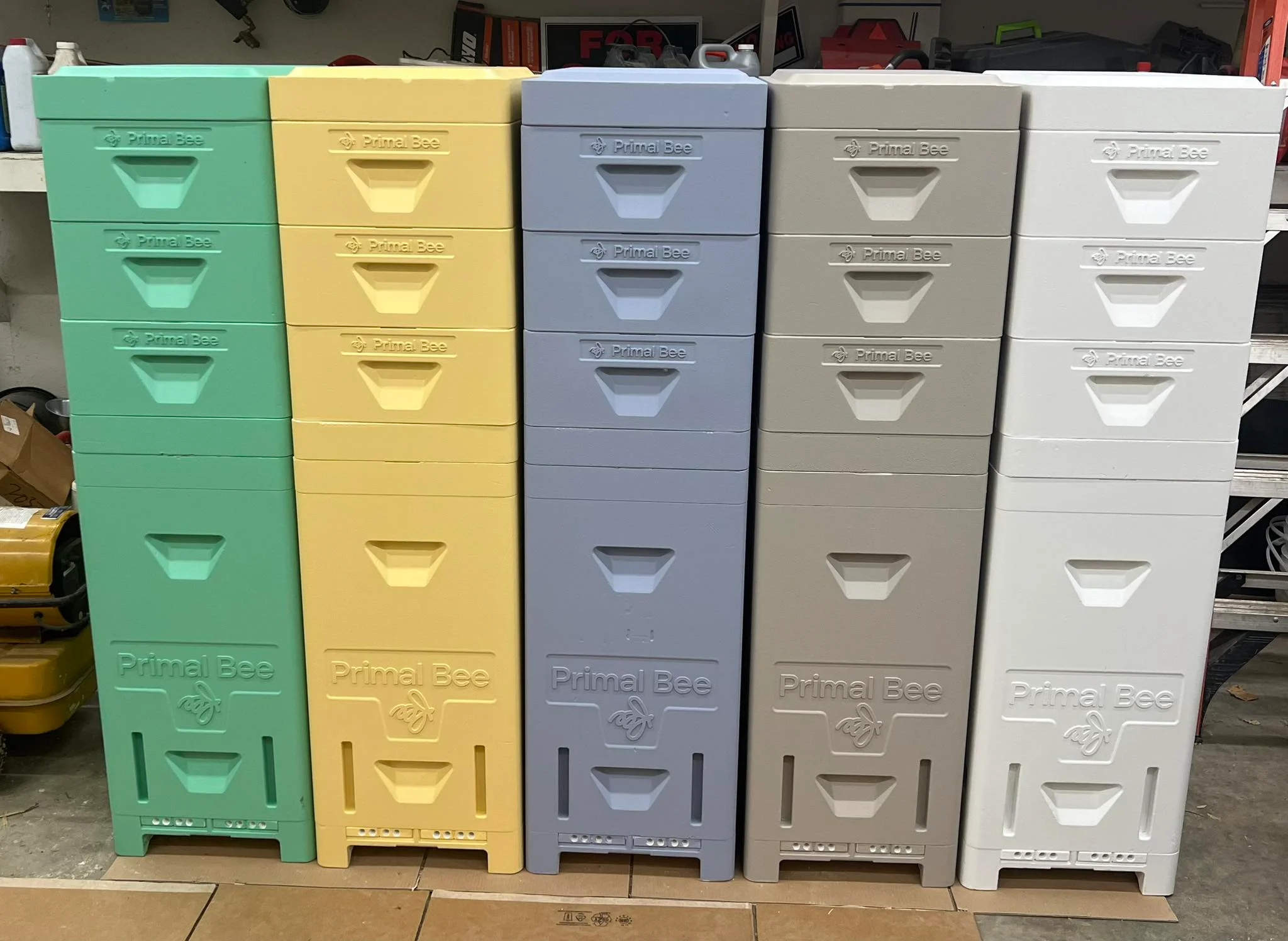
Five painted Primal Bee hives in green, yellow, blue, taupe and white lined up in a beekeeper's workshop

How to read this page

Measured
a counted or instrumented result from a defined test.
Lab-based estimate
calculated from a measured lab result and applied to real conditions.
Customer-reported
results beekeepers report from their own hives.
Measured

Whole-hive heat loss

500% more thermally efficient than a standard wooden hive

In our patented lab test, a heating unit fitted to each nest measured how much power it takes to hold a Primal Bee nest and a Dadant nest at a constant temperature. Claim 1 of U.S. Patent 11,375,697 defines the hive by a heat loss below 0.00600 W/(dm²·°C) at a 26°C temperature difference. The efficiency comes from three things working together: thick insulated walls, the shape and size of the nest, and a sealed design that keeps out drafts.

See the source

This measures heat loss, not honey or survival. The test ran on our 2017 prototype; today's hive uses higher-performing EPS.

Measured

Colony population

About 76,000 vs. 43,000 average emerging bees

In a 2017 field comparison with Swiss Cantonal Inspector participation, two groups of ten hives, Primal Bee and standard Dadant, were managed under the same protocol. Values are read from the issued patent plot (Fig. 20). The patent also reports lower mite-treatment needs in the Primal Bee group and lists the anomalies instead of removing them: one Dadant hive collapsed and one Primal Bee hive swarmed.

See the source
Measured (interim)

The 2026 almond pollination trial

59.9% vs. 48.6% almond fruit set

As part of the 2026 RegenUP2 initiative, we ran an almond pollination trial with Israel’s Ministry of Agriculture in two commercial orchards. The trial was monitored by an almond researcher and by bee and almond inspectors from the Ministry. In both orchards, Primal Bee hives were compared with conventional wooden hives.

Read the interim report

How it was set up

In the main orchard, the two hive types pollinated adjacent plots of the same almond variety on the same soil, so the hive was the main difference. Eight measurement trees were chosen in each plot at a uniform distance from the hives, and four branches per tree were tagged, one in each quadrant. Inspectors counted bloom buds on Feb 5 and fruit set on Feb 12, 2026.

What we found

  • Primal Bee hives reached 59.9% fruit set vs. 48.6% for conventional wooden hives, a lead of 11.35 percentage points and a 23% relative improvement (p = 0.0016).
  • Primal Bee led in 6 of the 8 matched trees.
  • The gap was largest where bloom was sparse: on branches averaging about 42 buds, fruit set was 64.2% vs. 35.6%. On the heaviest-bloom branches (about 71 buds), the two were close, 51.7% vs. 49.3%. That points to pollination as the limiting factor on sparser branches, which is where stronger colonies make the most difference.

The second orchard

Fruit set was 59.6% with Primal Bee vs. 55.3% with conventional wooden hives, a smaller gain that was not statistically significant. That orchard had half as many Primal Bee hives as conventional ones.

Interim results from the first count. A final count after natural nutlet drop will follow.

Lab-based estimate

Winter stores

About 13 lb vs. 66 lb of winter stores

Based on our lab heat-loss data, a Primal Bee colony needs about 13 lb of winter stores to hold its nest temperature, compared with about 66 lb in a standard wooden hive. Patent Fig. 23 shows the same heat loss as a monthly honey-equivalent cost.

See the source

A model from lab data, supported by beekeeper field observations. Your colony's needs depend on climate and colony size.

Customer-reported

Beekeeper results

Our recommended schedule calls for about 3 full inspections a year, compared with 12 to 24 for a typical Langstroth hive. When you do inspect, you check 7 nest frames instead of 20+, without taking the colony apart.

The inspection count compares how often tasks are needed on our recommended schedule with typical Langstroth practice. Mite monitoring is still part of every season.

Beekeepers using Primal Bee report up to 70% fewer inspections and interventions for hobbyist and sideliner operations, and about double the honey of standard hives under comparable conditions.

Read their stories
  • Daniel Reppen: 52 of 53 hives successful, about 2,600 lb of harvestable honey, and a worst weekly mite count of two.

  • Brett Reynolds: almost 100 lb from the supers.

  • Małgorzata Pietkiewicz: her BroodMinder sensors showed Primal Bee as the only hive still gaining weight during a dearth.

  • Dr. Jason Graham, senior beekeeping adviser: 4 supers in the hive's first year, then a split the following spring.

Peer-reviewed (supporting)

The research behind stable brood temperature

These studies explain the biology our design is built around. They show that the temperature brood is raised at affects how bees behave and how their brains develop (Tautz et al., 2003; Groh, Tautz and Rössler, 2005). That’s why holding the nest at a stable temperature matters.

See the science

Independent research on honey bees, not tests of Primal Bee hives.

What the hive does, and what’s still up to you

The hive gives your colony better starting conditions: less energy spent on heating and cooling, and more left for brood, foraging and stores. Mites, forage, weather, genetics, queen quality and your management still matter, and regular monitoring is still part of good beekeeping.

Getting started

  1. Pick your kit.

    Start with one hive or run it next to the hives you already keep.

    Find your kit
  2. Read the usage guides.

    Setup, your first inspection and seasonal care, step by step.

    Usage guides
  3. Talk to a beekeeper on our team.

    Book a call with questions about your climate or your operation.

    Book a call
  4. Join the community.

    Compare notes with beekeepers already running Primal Bee hives.

    Facebook community