
Colony health
Deformed Wing Virus: identifying and stopping it
Identifying Deformed Wing Virus from crumpled or shrivelled wings, why there is no spray or medication for the virus, and why the answer is hitting the parasite that spreads it. Also whether the colony is lost, late summer timing, and spread to other hives.
Deformed Wing Virus is the reason a heavy mite load kills a colony rather than merely weakening it. It is the mechanism behind most of the damage Varroa does, and it is what turns a mite problem into a dead hive.
Here is the part that catches people out. You cannot treat the virus. There is no spray, no medication, nothing to feed. The entire job is mite control, which is why this article is a companion to Varroa mite treatment and control in Primal Bee hives, where the actual work happens.
What to do, in order
- Confirm it. Newly emerged bees with stubby, crumpled wings, crawling and unable to fly.
- Understand the cause. This is a mite problem presenting as a wing problem. Do not go looking for a virus product.
- Count your mites. An alcohol wash gives you the number you act on.
- Bring Varroa down, hard. That is the treatment for DWV.
- Check the queen. A young, hygienic queen speeds recovery.
- Verify. Count again after the treatment cycle.
What it is
DWV is a virus vectored by Varroa mites. On its own it is mostly background noise: without Varroa it produces largely asymptomatic infections and does little harm. The mite is what turns it into a colony-killing disease, which is why it belongs alongside mite management rather than in a list of diseases with their own cures.
The Texas Apiary Inspection Service describes it as a worldwide disease "often associated with high Varroa mite populations," producing adults with "twisted, shriveled wings, bloated abdomens, decreased body size, and discoloration," and impaired cognitive function. Timing of infection matters: bees infected as pupae at the white-eye stage may emerge malformed and die soon after, while earlier infections are usually fatal during development.
The colony-level effect follows from that arithmetic. As mite pressure climbs, a rising share of emerging bees come out unable to fly and unable to work. The adult population shrinks faster than it is replaced, the brood area contracts, and the colony spirals. A colony with high Varroa and active DWV does not pull out of that on its own.
How to identify it
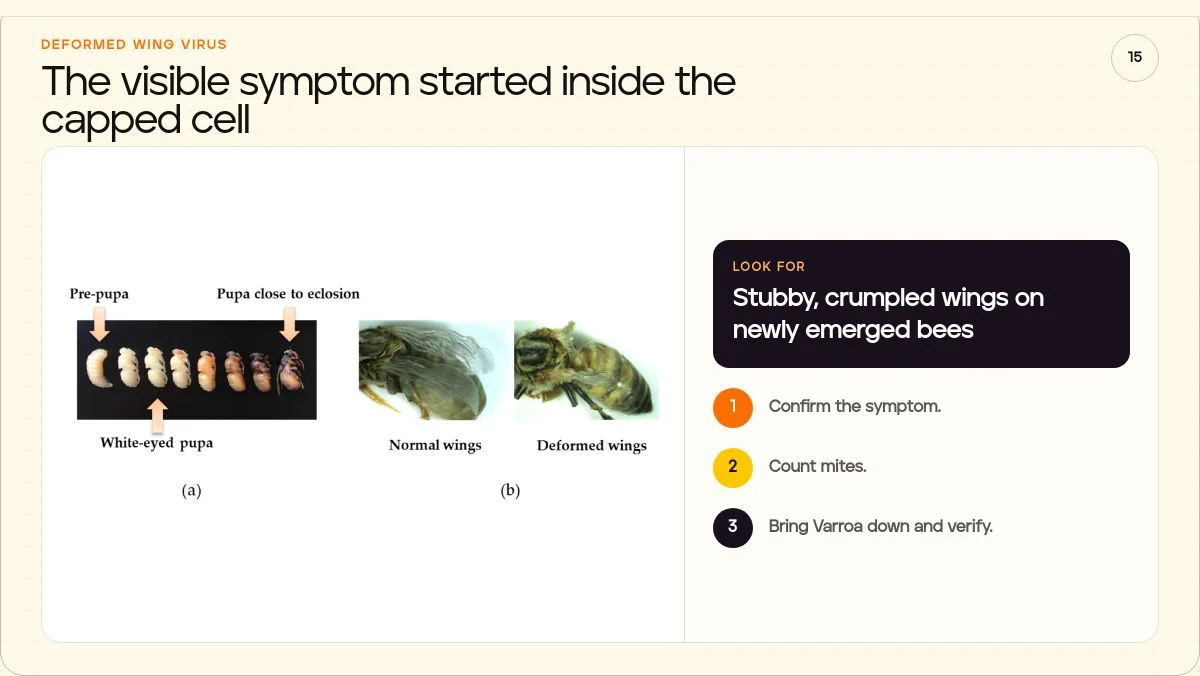
You will usually see the bees before you understand the cause. Three field signs:
Newly emerged bees with stubby, crumpled, unusable wings, often with a shortened, rounded abdomen and a smaller body. The wings look shrivelled rather than torn. Damage from age or handling looks ragged; DWV wings never formed properly in the first place.
Bees crawling and unable to fly, on the ground in front of the hive or on the landing board. House bees expel affected bees, so the ground at the entrance is where you spot them. This is the sign most beekeepers notice first.
A rising share of deformed bees through the season, alongside a shrinking population. One deformed bee is not a diagnosis. A trend is.
If you are seeing this, treat it as a strong signal that mite pressure is high and confirm it with a count. An alcohol wash gives you an infestation percentage; the Varroa tray gives you the trend. Both methods, and the thresholds you act on, are in the mite control article.
The Varroa link, briefly
The mite injects viral particles into the developing pupa while feeding inside the capped brood cell. The virus rides the mite into the next generation of bees, cell by cell, and each infested cell is another chance for it to establish.
That single fact is why mite control is the only effective lever. Cut the mite population and you cut the virus's route into the brood. There is nothing useful to apply to an adult bee that already has deformed wings, because the damage was done in the cell before she emerged.
What actually works
Bring Varroa down aggressively. This is the treatment for DWV. In a Primal Bee hive that means oxalic acid sublimation applied through the feeder hole in the feeder lid, starting at 1 g per application, five applications every 5 to 7 days across a full brood cycle of 25 to 30 days. Do not carry a wooden-hive dose into this hive: the seal retains vapour, so a standard dose can over-concentrate. The full protocol, the sourcing behind the dose, and the heat-safety rules for EPS are in Varroa mite treatment and control in Primal Bee hives. The Texas Apiary Inspection Service puts it plainly: the most effective way to treat DWV is by controlling mite populations within colonies.
Support the queen. A young, healthy queen from hygienic stock is better equipped to keep the colony finding and removing mite-infested brood, which breaks the cycle faster than treatment alone. If the queen is old, or the colony is struggling to rebuild after you have brought mites down, requeen.
Let healthy bees replace the deformed ones. Once mites are controlled, the colony raises healthy brood again and the population rebuilds. Recovery is realistic, and it is faster with a strong queen. What you cannot do is repair the bees that already emerged deformed.
Keep monitoring. Confirm the mite count actually dropped, then stay on your monitoring rhythm. Symptoms lag the mite population by weeks in both directions, so an improving hive front is not proof the mites are gone.
What not to do
Do not look for a virus treatment. None exists, and time spent searching is time the mites keep working.
Do not dismiss a few deformed bees. A small but rising proportion is an early alarm, and it is the most useful moment you will get. Varroa populations rebound quickly once brood rearing is underway: Jack et al. (2023) found colonies treated in summer or autumn were back above the economic threshold of 3 mites per 100 bees in under three months.
Do not relax monitoring once symptoms ease. The deformed bees you can see reflect mite pressure from weeks ago. Judge the situation on counts, not on the landing board.
Do not assume it stays in one hive. Mites move between colonies on drifting and robbing bees, and the virus moves with them. If one colony in an apiary is symptomatic, count the others.
Timing: why late summer matters most
Late summer is when the colony raises the long-lived winter bees that carry it through to spring. Those bees have to live for months rather than weeks, and mites hitting them do disproportionate damage. A colony that raises its winter bees under high mite pressure and active DWV usually looks acceptable in October and is dead or hollow by March.
This is why the late-summer alcohol wash threshold is lower, 1 to 2% rather than the 3% used during the active brood season, and why the autumn treatment is the one that decides the winter. Finish it early enough that the colony recovers before it clusters.
How the Primal Bee hive fits in
The biology is identical in any hive: DWV tracks Varroa. What differs is the colony's resilience and how reliably your response lands.
A Primal Bee colony sits inside a high-density EPS shell, over 90 kg per cubic metre, that holds the nest microclimate steady. A colony that is not spending its energy fighting the weather has more to put into hygienic behaviour, grooming and uncapping infested brood among it. Thermal stress suppresses bees' antimicrobial peptides, their primary immune defence, so a colony that is not thermoregulating hard has more immune capacity in reserve. And the stable, sealed microclimate is what makes oxalic acid sublimation distribute uniformly through the nest, so your mite control works more consistently than it would in wood.
None of that prevents DWV, and none of it removes the need to manage mites. It improves your odds when you do the work.
Frequently asked questions
Is there a spray or medication for Deformed Wing Virus?
No. There is no product that treats the virus in an infected bee, and there is nothing to go looking for. The only effective response is to reduce the Varroa population that spreads it, which is the position the Texas Apiary Inspection Service takes too: controlling mite populations within colonies is the effective way to treat DWV. Go to the mite control article, count your mites, and treat against your threshold.
How do I know it's Deformed Wing Virus and not wing damage from something else?
DWV wings never formed properly, so they look stubby, shrivelled, and crumpled, often with a shortened rounded abdomen and a smaller body overall. Wear and tear on an older forager looks different: ragged, frayed edges on wings that are otherwise full size. DWV also shows up on newly emerged bees specifically, and affected bees cannot fly, so you find them crawling on the ground in front of the hive or on the landing board after house bees expel them.
My bees have deformed wings. Is the colony lost?
The individual deformed bees will not recover, but the colony can. Once you bring the mite population down, the queen raises healthy brood again and the population rebuilds. A young, hygienic queen makes that recovery faster and more reliable, so requeening is worth considering if the queen is old or the colony is struggling. What determines the outcome is how fast and how thoroughly you act on the mites.
I only see a few deformed bees. Can I wait?
No. Run a wash now. A few deformed bees is an early alarm rather than background noise, and it is the most useful moment you will get, because acting while the count is just over threshold is far easier than recovering a colony that is already spiralling. Varroa rebounds quickly during brood rearing, and the deformed bees you can see reflect mite pressure from weeks ago.
What causes Deformed Wing Virus?
Varroa mites. The mite injects viral particles into the developing pupa while feeding inside the capped brood cell, and the virus rides the mite into each new generation of bees. Without Varroa, DWV produces mostly asymptomatic infections and does little harm. The mite is what turns a background virus into a colony-killing disease, which is why mite control is the entire treatment.
What happens if I ignore Deformed Wing Virus?
The colony declines progressively and does not recover on its own. More emerging bees are deformed and unable to forage or nurse, the adult population shrinks faster than it is replaced, the brood area contracts, and the colony collapses. It also becomes a mite and virus source for neighbouring colonies through drifting and robbing, so ignoring it in one hive puts the rest of the apiary at risk.
How do I treat mites in a Primal Bee hive to stop DWV?
Oxalic acid sublimation, applied top-down through the feeder hole in the feeder lid, is the recommended method. Start at 1 g per application, which is approximately half the wooden-hive equivalent, because the hive retains vapour rather than venting it. Run five applications every 5 to 7 days to cover a full brood cycle of 25 to 30 days, since vapour does not reach mites under cappings. Never carry a standard wooden-hive dose into this hive, and keep the hot vaporiser tip clear of the EPS. Full detail is in Varroa mite treatment and control in Primal Bee hives.
Should I requeen a colony with DWV?
Consider it, especially if the queen is old or the colony is slow to rebuild after you have brought mites down. A young queen from hygienic stock helps the colony detect and remove mite-infested brood, which attacks the problem at the source and speeds recovery. Requeening is a support measure, not the fix: it does nothing on its own if the mite population is still high.
Does the Primal Bee hive prevent Deformed Wing Virus?
No, and any hive that claimed to would be overselling. DWV tracks Varroa, and you still manage mites. What the hive does is give the colony more immune and hygienic capacity by lowering thermal stress, and make oxalic acid sublimation distribute more uniformly through the nest, so the mite control you do apply works more consistently. Better odds, not a shortcut.
When should I be most worried about DWV?
Late summer and early autumn, when the colony is raising the long-lived winter bees it depends on to reach spring. Mites hitting those bees do disproportionate damage, which is why the late-summer alcohol wash threshold drops to 1 to 2% from the 3% used during the active brood season. A colony that raises its winter bees under high mite pressure often looks fine in autumn and fails over winter.
Can Deformed Wing Virus spread to my other hives?
Yes, indirectly. The virus travels with the mites, and mites move between colonies on drifting bees and during robbing. If one colony in your apiary is showing deformed bees, count the others rather than assuming the problem is contained. Treating a whole apiary on the same schedule also reduces reinfestation, which is a common reason a single treated colony's counts climb straight back up.