
Colony management
How to feed bees in a Primal Bee hive
When to feed and when to stop, how to mix and store 4:1 sugar syrup and why it beats thin syrup, which jar fits the feeding system, and how to use bucket feeders, candy boards, fondant, and a pollen patty without starting a robbing war.
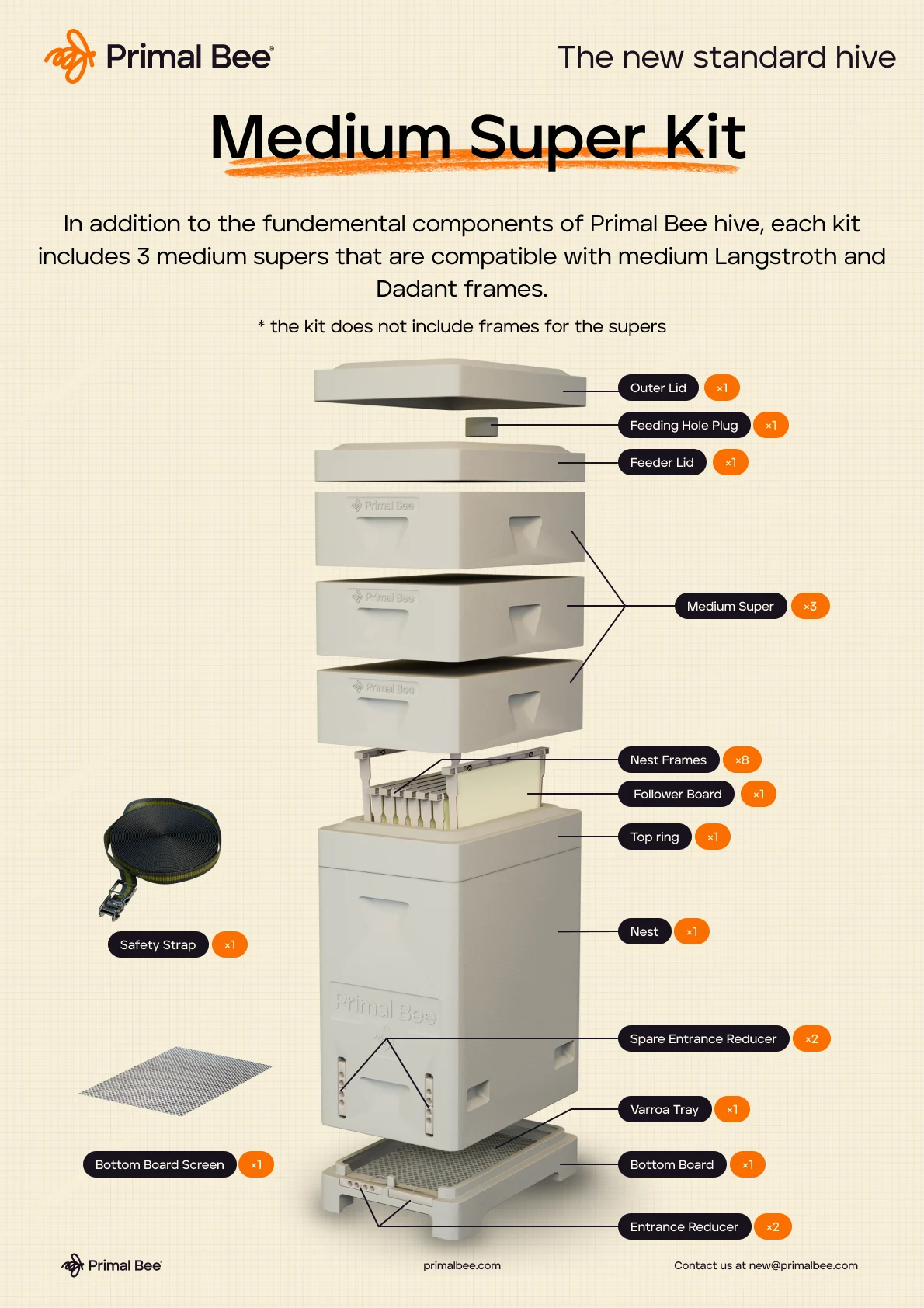
Your Primal Bee hive has a feeding system built into it: a hole in the feeder lid on top of the nest box, with a super above it that becomes a feeding chamber. This guide covers when a colony actually needs feed, how to deliver it through that hole without wrecking the thermal seal or drowning bees, what syrup to mix, and when solid feed is the better answer.
Why a Primal Bee colony needs less feed
Feed is fuel, and in a poorly insulated hive much of that fuel is burned as heat leaking out through the walls. The insulated shell reduces that loss, so more of what the colony eats goes into wax, brood, and stores. Winter stores draw down more slowly, and autumn feeding is often lighter than a wooden-hive schedule would suggest.
Less feeding is not no feeding, though, and establishment, dearth, and recovery still call for it. Don't feed to a calendar: check the hive's actual weight and the state of the frames, then decide.
When do I need to feed?
Feed when the colony can't yet supply itself, not as a routine.
- New installations. Packages, swarms, and freshly transferred colonies arrive with no stores. Feed immediately after installation and keep it up until comb is established and natural stores are visible.
- Comb building on new foundation. Drawing wax is expensive. Heavy syrup is the biggest lever you have on how fast a new colony builds out.
- Gaps in forage. Early spring before the first bloom, and summer dearth or drought.
- Recovery. After disease treatment, a swarm, or a queen problem.
- Late-season transfers. A colony moved in late will lean on you for feed through winter until the next flow.
If a colony has capped stores on the outer frames and forage is coming in, leave it alone.
The feeder hole is for feeding, not ventilation
The hole in the feeder lid has one job. When you are not actively feeding, it stays closed with the plug supplied with your hive. Leaving it open costs you twice: it breaks the thermal seal the hive depends on, and it opens a second entrance the guard bees can't cover, which invites robbing. Replace the plug if it stops sealing flush and tight.
Jar feeding: the default method
An inverted mason jar over the feeder hole is the go-to method for most situations. It's cheap, easy to monitor, and it delivers feed inside the hive where robbers can't reach it. A regular-mouth, quart-size mason jar fits the Primal Bee feeder system with either medium or deep supers.
- Punch about 5 to 10 small holes in the jar lid with a nail.
- Fill the jar roughly three-quarters full of dry sugar, then add warm water and stir or shake until dissolved.
- Invert the jar away from the hive and let it drip until the drip slows or stops. Vacuum from the air pressure above the liquid holds the rest in.
- Set the inverted jar over the feeder hole, then replace the super and outer lid.
The bees reach up through the holes with their proboscis and will add propolis or wax around the lid to regulate the flow themselves. A small spill inside gets cleaned up quickly, but keep syrup off the outside of the hive and off the ground nearby, since that's what draws ants and rodents.
Do not use a feeder jar while the feeder net is in place
Warning
Never place a feeder jar over the feeder hole while the feeder net is installed. The feeder net is only for use between feedings, to stop bees leaving the nest box. Remove it before you put the jar on, and never run both at once.
Other feeders that work
The blue Universal Direct Feeder. Fits over the feeder lid hole and holds a gallon, which should last a single colony a couple of weeks depending on its appetite. Centre it directly over the hole, or bees escape up into the feeding chamber.
Bucket feeders. These work, but they need more headroom, so you'll build the feeding chamber out of two supers instead of one.
Internal frame feeders. Not recommended. They take up the space of several frames, raise moisture inside the nest, and drown bees.
External feeders. Reserve these for large volumes or multi-colony operations. Feeding outside the hive during a dearth is a reliable way to start a robbing frenzy in your own apiary.
What syrup to feed, and why 4:1
The Primal Bee standard is 80% sugar to 20% water, which is 4 parts sugar to 1 part water by weight. Measure by weight, not volume.
Two reasons for going that heavy. Less moisture: thin syrup carries a lot of water into the hive, and damp conditions are what Nosema ceranae likes. Less work: bees have to evaporate water out of syrup before they can cap it, and at 4:1 you're handing them something already close to honey's sugar concentration, so far more of their energy goes into drawing comb.
One purpose-specific exception. When you're delivering medication through feed, such as a Nosema treatment, use a thinner 60% sugar to 40% water mix. The thinner syrup moves through the colony faster and distributes the medicine more evenly. That's a delivery decision, not a nutrition one. Return to 4:1 once the course is finished.
How to make, fix, and store 4:1 syrup
- Weigh your ingredients. For every 1 lb (0.45 kg) of water, you want 4 lb (1.8 kg) of sugar.
- Heat the water until very hot but not boiling.
- Off the heat, add the sugar slowly while stirring continuously.
- Keep stirring until fully dissolved. This takes several minutes and some patience. If sugar is still sitting undissolved, reheat gently while stirring.
- Cool completely to room temperature before feeding.
Warning
Never boil syrup. Boiling creates hydroxymethylfurfural (HMF), which is toxic to bees. Hot syrup can also harm bees directly and encourage fermentation.
Hot water matters because it holds far more dissolved sugar than cold. At 4:1 you're near the limit of what will stay in solution, and cold water simply won't take it up.
Syrup that crystallizes either got too hot, so water evaporated and the sugar dropped out on cooling, or wasn't stirred enough, so undissolved crystals seeded more. Fix it by reheating gently in a water bath, not over direct heat. Store finished syrup in airtight, food-safe containers at room temperature for two to three weeks, discard it if you see mould or smell fermentation, and make fresh batches rather than stockpiling.
Honey beats syrup
If you have honey from your own frames, feed that instead. It's nutritionally superior and bees accept it more readily. This comes up most often during a transfer, when there's honey sitting in the old frames you're leaving behind. Deliver it the same way as syrup, through a jar over the feeder hole: honey in an open container invites robbing and spreads disease. Only ever feed honey from your own healthy hives.
Solid feed: candy boards, fondant, and pollen patties
Put candy boards, fondant, or protein patties on wax paper or parchment paper, laid directly on top of the nest frames, between the frames and the feeder lid. Don't cover the feeder hole. With patties, peel the paper back as the bees work through it.
Why solid feed in winter. Below roughly 50°F (10°C) bees can't process and evaporate liquid syrup, so a full feeder jar above a cluster is no help at all. A candy board adds no moisture, doesn't freeze, and stays within reach even when the cluster can't break apart to travel. It's emergency and supplemental feed, not a substitute for adequate honey stores.
Pollen patties are protein, not energy. Give them in spring, a few weeks before your first major bloom, so the queen ramps up laying and the colony peaks as the flow starts. In autumn, deal with mites first.
Feeding through the season
Feed in spring if stores are low, and feed a new install continuously until forage arrives. Summer feeding is usually unnecessary outside a genuine dearth, and syrup above about 90°F (32°C) ferments fast, adds humidity, and draws robbers. In autumn, assess actual stores and feed heavy syrup if they're short so the bees can cap it before it turns cold, remembering that an insulated colony may need less than you're used to. In winter, stop liquid feed once nights are consistently below 50°F (10°C) and switch to a candy board or fondant.
Feeding without starting a robbing war
Syrup smells like a free meal for miles around, and a dearth is exactly when you're most likely to be feeding. Feed inside the hive through the feeder hole rather than externally, reduce the entrance to its smallest setting while feeding, feed in the evening once foraging has wound down, and never leave honey, wax, or exposed feed anywhere in the apiary. If robbing has already started, close the entrance almost completely with a mesh robbing guard for a day or two until the robbers give up.
Reading whether your feeding is working
It's working when jars empty steadily, new comb appears, brood patterns improve, and the population climbs.
You'reoverfeeding when syrup is going into brood frames, brood space is shrinking, and the nest is turning honey-bound. Back off the volume or frequency.
They're refusing it when the jar just sits full. Check that the syrup is fresh, that it dissolved properly, that the gear is clean, and that the feeder net isn't still in place.
Lifting the outer lid to check the jar also shows how densely the bees are covering the frames below, which is a far cheaper check than a full inspection.
Frequently asked questions
What sugar-to-water ratio should I feed my bees, and why not 1:1 or 2:1?
Primal Bee's standard is 80% sugar to 20% water, which is 4 parts sugar to 1 part water by weight. Measure by weight, not volume. It's heavier than the usual 1:1 or 2:1 for two reasons: less moisture, since thin syrup encourages the damp conditions Nosema ceranae thrives in, and more efficiency, since thick syrup is closer to honey's natural sugar concentration so the bees spend far less energy evaporating water before they can cap it.
What kind of jar fits in the Primal Bee feeder system?
A regular-mouth, quart-size mason jar fits with both medium and deep super configurations. Punch about 5 to 10 small holes in the lid with a nail, fill it roughly three-quarters full of dry sugar, add warm water, and stir or shake to dissolve.
Can I leave the feeder net on while using a feeder jar?
No. Do not use a feeder jar while the feeder net is in place. The feeder net is only for use between feedings, to prevent bees leaving the nest box. Remove it before you insert the feeder jar, and never use both at the same time.
How do I stop the feeder jar dripping syrup into the hive?
Punch 5 to 10 small holes rather than large ones, and invert the jar away from the hive first. It drips at first, then stops as vacuum from the air pressure above the liquid takes hold. Once it has slowed, place it over the feeder hole. Small spills inside get cleaned up by the bees, but keep syrup off the outside of the hive so you don't attract ants or rodents.
How do I install the Universal Direct Feeder?
The blue Universal Direct Feeder fits over the Primal Bee feeder lid hole. Centre it directly over the hole, because bees can escape up into the feeding chamber if it sits off-centre. It holds a gallon, which should last a single colony a couple of weeks depending on its appetite.
Can I use a bucket feeder on a Primal Bee hive?
Yes, though a bucket needs more vertical clearance than a jar, so you'll need two medium or deep supers to build a tall enough feeding chamber rather than the single super a jar needs.
Can I leave the feeder hole open for ventilation?
No. Never use the feeder hole for ventilation. When you aren't actively feeding, keep it closed with the plug supplied with your hive. Leaving it open breaks the hive's thermal seal and creates a second entrance the guard bees can't defend, which invites robbing.
Should I feed honey instead of sugar syrup?
Yes, if you have your own honey. It's nutritionally superior and bees accept it more readily, which comes up most often during a transfer when you can feed honey from the old frames you're leaving behind. Feed it through a jar over the feeder hole rather than in an open container, and only ever use honey from your own healthy colonies.
Do I need to boil sugar syrup?
No, and you shouldn't. Heat the water until very hot but not boiling, take it off the heat, and stir the sugar in until fully dissolved. Boiling creates hydroxymethylfurfural (HMF), a compound toxic to bees. Let the syrup cool to room temperature before feeding it.
My 4:1 syrup turned into candy or crystallized. What went wrong?
Either it got too hot, so water evaporated and the sugar crystallized as it cooled, or it wasn't stirred enough, so undissolved crystals seeded more. Prevent it by adding sugar to hot but not boiling water and stirring constantly until fully dissolved before any cooling starts. Fix it by reheating gently in a water bath, not over direct heat.
How much syrup should I make, and how long does it keep?
Make one to two weeks' worth at a time. Stored in airtight, food-safe containers at room temperature it keeps two to three weeks, and should be discarded if you see mould or smell fermentation. A colony drawing comb goes through a jar quickly, so measure your own consumption in the first week and size later batches to match.
Do I feed a different syrup when I'm giving medication?
Yes. For medication delivery, such as a Nosema treatment, use a thinner mix of 60% sugar to 40% water. The thinner syrup moves through the colony more readily so the medicine distributes evenly. Return to the standard 80/20 mix once the treatment is finished.
How do I feed solid food or protein patties?
Place candy boards, fondant, or protein patties on wax paper or parchment paper and set them directly on top of the nest frames, between the frames and the feeder lid, without blocking the feeder hole. Peel the paper back as the bees work through the patty to expose fresh feed.
What is a candy board, and why would I use one in winter?
A candy board is solid sugar feed, either hard candy or softer fondant, set on top of the nest frames for the bees to eat over winter. Unlike liquid syrup it adds no moisture, doesn't freeze, and stays reachable even when the cluster can't break apart to travel. It's emergency and supplemental feed, not a replacement for adequate honey stores.
When should I stop feeding liquid syrup in autumn?
Once night-time temperatures are consistently below 50°F (10°C). Below that the bees can't process and evaporate liquid syrup, and uncapped syrup sitting through winter can ferment or push humidity to a problematic level. If the colony still needs feed, switch to fondant or a candy board on the frames.
When should I give pollen patties?
In spring, a few weeks before your first major bloom, so the queen ramps up laying and the colony peaks just as nectar starts flowing. A patty also helps a newly transferred colony once it has drawn a frame or two. In autumn, deal with Varroa first; autumn patties have less impact than spring ones.
Can I feed in hot weather?
Avoid feeding syrup above about 90°F (32°C). It ferments quickly, adds humidity inside the hive, and attracts robbers. If you must feed anyway, do it in the evening once temperatures drop, feed smaller amounts, and check often. Syrup that has gone cloudy or smells sour should be removed.
How do I feed without triggering robbing?
Feed inside the hive through the feeder hole rather than externally, reduce the entrance to its smallest setting while feeding, feed in the evening, and avoid spilling syrup on or near the hive. Never leave honey, wax, or exposed feed out in the apiary during a dearth. If robbing has started, close the entrance almost completely with a mesh robbing guard for a day or two.
How can I tell if I'm overfeeding?
Look for syrup stored in the brood frames, shrinking brood space, and a honey-bound nest where the queen has nowhere left to lay. Those are signs to cut the volume or frequency. Feeding is a tool for getting a colony through a gap, not a permanent state.
Do I need to feed my bees if I transfer them late in the season?
Yes. A colony moved late in the year will depend on you for feed, whether syrup, pollen, or fondant, from the transfer through winter until forage resumes in spring. Move them while weekly average temperatures are still around 60°F (15°C) or warmer. With adequate feeding, a late-started colony has a good chance of overwintering in a Primal Bee hive.
Does a Primal Bee hive really need less feeding than a wooden hive?
Generally yes. The colony spends less energy holding brood temperature, so more of what it eats goes into comb, brood, and stores. Winter stores draw down more slowly and autumn feeding is often lighter than a wooden-hive schedule suggests. Check actual hive weight and frame stores rather than feeding to a fixed calendar.