A long winter and a noisy spring
Bees need stable temperatures and humidity to survive, they need food, and they need protection from pests. Nobody anywhere in beekeeping disagrees with any of that. What gets argued about - loudly, on every forum, every spring - is how to deliver those things, and the arguments tend to get sharper after a winter like the one we just came out of.
The 2024-2025 commercial loss numbers were the highest on record per Auburn University's national survey, and the conversations on major forums like Beesource, BeekeepingForum.co.uk, and r/Beekeeping have been processing the aftermath since the snow melted. Three debates in particular have been doing most of the work this season - they're not new arguments, and none of them got resolved this winter, but all three are worth understanding before you make decisions in your own yard.

We're going to walk through each one, explain what each side actually argues, point to where the conversations are happening and to the research that exists, and then - because we do have opinions, and you deserve to hear them - close each section with where Primal Bee lands and why.
Debate one: how (and how much) to manage varroa
This is the longest-running and most personal argument in hobbyist beekeeping. It's been running for two decades at this point, and there's no real sign of resolution coming.
What the spectrum actually looks like
Most beekeepers fall somewhere along a continuum rather than at one of the two extremes. The two extremes are the treat without monitoring camp (where beekeepers treat aggressively without bothering to monitor, assuming varroa will be a problem) and the never treat camp (treatment-free beekeepers who avoid chemical treatments entirely). Between those poles sits a much larger middle: the Integrated Pest Management (IPM) camp. IPM involves treating based on reliable monitoring observational data over time, using all the tools available to better understand and control the mite population without harming the bees. This approach utilizes mechanical methods, drone trapping, brood breaks, soft chemicals like oxalic acid, and treatments timed carefully against sampling data.
What each camp argues
Rather than adhering to the extreme "treat without monitoring" camp, many sources now align with the middle-ground approach of Integrated Pest Management (IPM).

If we look at Randy Oliver of Scientific Beekeeping, Rusty Burlew of Honey Bee Suite, and most state extension services, they say that without active mite management, colonies in most landscapes will eventually collapse from varroa-vectored viruses. The Honey Bee Health Coalition's IPM tools have become the go-to resource, laying out a framework of monitoring with alcohol washes, treating once you cross established thresholds, and choosing treatments that match the season and brood status of the colony.
The case against - made by Michael Bush, Solomon Parker (host of the Treatment-Free Beekeeping Podcast), and the large treatment-free beekeeping community online - is that chemical treatments interfere with natural selection for resistant bees, and that the mite-resistant populations we already have (Gotland, Pol-line, Russian, VSH-selected lines) demonstrate that the real long-term path forward is genetic rather than chemical.
What most working beekeepers actually do sits somewhere between the two: monitor regularly, intervene when necessary, prefer the lightest-touch tool that does the job, and start from the best stock you can find.
Where the research lands
The peer-reviewed evidence presents a complex picture rather than a single certain answer. Peck and Seeley's 2019 study confirmed that collapsing colonies can spread mites to neighboring apiaries through robbing behavior. This finding lends weight to the "mite bomb" theory—the concept that a collapsing, heavily mite-infested colony releases a massive number of mites that are then carried by robber bees to healthy neighboring hives—is often cited by critics of treatment-free beekeeping. Conversely, mite-resistant breeding programs at several universities have demonstrated that genetic selection can produce verifiable and reproducible results, suggesting that the goal of breeding for resistance is a viable long-term strategy.
What both sides tend to gloss over is that colony health is multifactorial. Mites are the biggest single driver of winter loss in most studies, but nosema, queen quality, forage quality, weather, and beekeeper skill all play substantial roles. Anyone telling you mites are the only reason colonies fail is leaving things out - as one example, the energy cost of brood rearing alone accounts for roughly half of what an average colony brings in during a decent season, and that math doesn't change based on which mite strategy you've chosen.
Where this is playing out:
- Beesource: "Varroa treatment-free colony losses in the European honey bee: a review of published literature"
- Beesource: "what is your mite treatment of choice?"
- BeekeepingForum.co.uk: "Varroa treatment?"
Where we land
Both camps have legitimate ground to stand on, and we don't think either side should be excluded from a thoughtful conversation about bee health. What we do believe - and what the research backs up - is that the hive itself is doing a lot more work in this equation than most of the debate gives it credit for. A hive that holds temperature well, retains humidity, and allows bees to regulate internal conditions with less metabolic effort produces stronger colonies, and stronger colonies manage mite pressure better regardless of which treatment philosophy their beekeeper follows.
Our own field experience, and the biology it's built on, points the same direction: when bees aren't burning energy fighting their housing, their immune systems, their grooming behaviors, and their ability to mount a coordinated response to pests all improve. We're not suggesting any hive replaces varroa monitoring - it doesn't, ours included - but we are saying that treatment-free beekeepers using our hive have tools they didn't have in a wooden box, and treating beekeepers get better outcomes from the same interventions they were already doing. Both paths get easier. That's the position we hold, and that's what our design is built to support.
Debate two: how to manage moisture in winter
For about 40 years, the dominant North American advice has been pretty consistent: add an upper entrance, give moisture a way to escape, prevent condensation from dripping onto the cluster. That consensus is now being actively re-examined by people who, until recently, would have considered it settled.
What each camp argues
The traditional ventilating hive approach assumes the danger in winter is condensation, and the signature setup is familiar to anyone who's been beekeeping more than a few years - a small upper entrance, a quilt box or moisture board to absorb water vapor, often a screened bottom board left open. Michael Palmer, the University of Minnesota Bee Lab, and most older beekeeping books endorse versions of this, and the underlying mental model is straightforward: let the moisture escape upward before it has a chance to condense and drip.

The newer "condensing hive" framework, championed by Bill Hesbach (EAS Master Beekeeper, American Bee Journal columnist), proposes nearly the opposite.
Drawing on Tom Seeley's research into feral colonies in tree cavities - which typically have just one small lower entrance and substantial insulation overhead - Hesbach argues for heavy top insulation, moderate side insulation, no upper entrance, and a single small lower entrance. The mechanism, in his telling, is that warm moist air rises to a warm insulated ceiling where it stays in vapor form, then migrates down to cooler walls where it condenses harmlessly - and the bees actually drink the condensate. A secondary mechanism worth flagging is that a sealed insulated environment retains more CO₂, which has been shown to suppress varroa reproduction.
Where the research lands
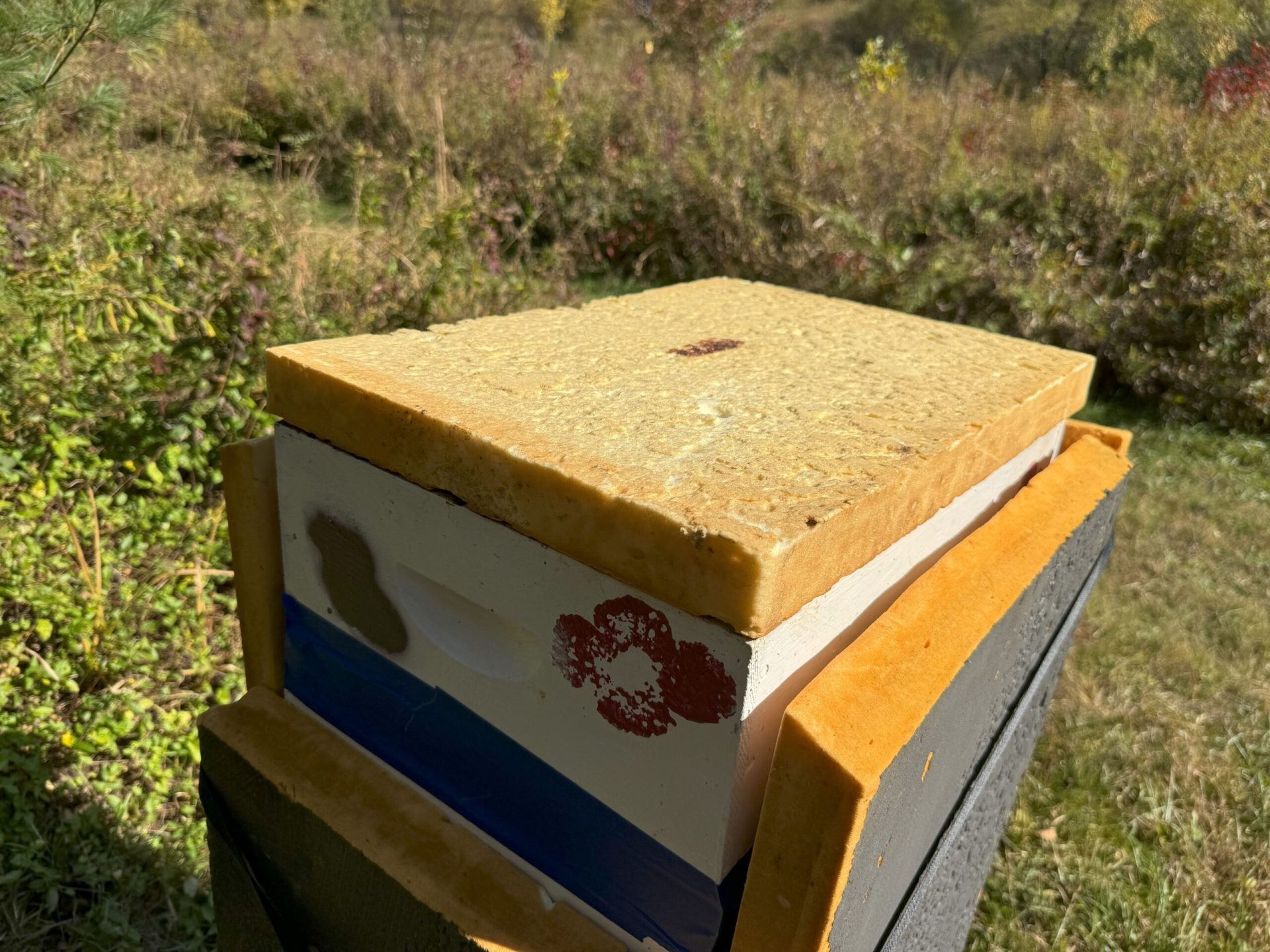
Some of the underlying claims are well-supported. Mitchell's 2016 work in the International Journal of Biometeorology established that bees in standard wooden hives lose heat 4-7 times faster than bees in tree cavities, and comparative studies of polyurethane vs. wooden hives consistently find insulated hives maintain warmer temperatures and require less supplemental feeding.
Other claims are still developing - the 30-50% honey-consumption reduction that some condensing-hive advocates cite comes from field observations rather than large peer-reviewed trials, and the CO₂-and-varroa connection is consistent with observations but is still being studied.
The failure mode critics keep raising is real and worth taking seriously: if the single lower entrance ices over in a hard freeze, the colony can suffocate, which is why most beekeepers experimenting with condensing setups end up hedging with a small backup vent for exactly that reason.
Where this is playing out:
- Beesource: "Condensing Hive? (NO upper entrance)" - 11+ pages of active debate
- Beesource: "Condensing Hives / Bill Hesbach Betterbee Interview"
- Betterbee's explainer: "Understanding the Condensing Hive Concept"
- BeeListener: "The Winter Cluster & The Insulation Question"
Where we land
We're firmly in the condensing-hive camp, and we have been since before the term had caught on. The physics is clear, Seeley's biology is clear, and Derek Mitchell's thermal engineering work is clear - bees didn't evolve to live in drafty wooden boxes with vents at the top, and the ventilating hive tradition exists mostly because the Langstroth design couldn't hold heat well enough to avoid dripping condensation without help. That's a workaround, not a design goal.
Our hives are built around exactly the principles Hesbach articulates: heavy top insulation, sealed construction with a single controlled entrance, and no moisture board or quilt box because the thermal envelope doesn't need one. In a well-insulated hive, warm air doesn't hit a cold ceiling and drip - it stays in vapor form, migrates down to cooler walls, and either gets reabsorbed or provides bees with water in the dead of winter, which is when they most need it and can least get it outside. That's how tree cavities work, and it's how we think hives should too.
If you're running a wooden Langstroth, an upper entrance is probably still the right call for you - the physics of that system genuinely does require it. That's not a knock on the beekeepers who do it. It's a reason we build our hives differently.
Debate three: insulated hives vs. uninsulated wooden hives
For a long time this debate split along regional lines, with most European commercial operators running insulated polystyrene hives and most North American beekeepers running wood, and the two sides mostly content to ignore each other. The last five years of accumulating data - and a series of unusually brutal winters - have pulled the conversation into the mainstream on both sides of the Atlantic.
What each camp argues
The case for insulated hives starts with thermal physics. Wooden Langstroth walls have R-values around 0.84 (Mitchell, 2016), versus tree cavities that effectively offer much higher insulation, and large commercial operators like Murray McGregor in Scotland have reported substantially better winter survival running poly. Comparative thermal studies consistently show measurable temperature stability and reduced feeding costs.

The case for wood isn't really a counter-argument so much as a different set of priorities. Wood is durable, lasts decades, and has a long operational track record. Bees readily propolize wood, which has antimicrobial benefits. Polystyrene is more fragile, doesn't propolize the same way, and some beekeepers find it susceptible to physical damage from hive tools or pests.
Where the research lands
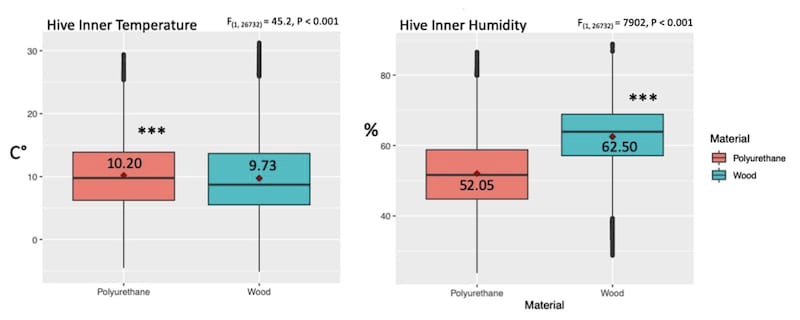
On thermal performance specifically, the research is one-sided: insulated hives outperform uninsulated wooden hives on temperature stability, supplemental feeding requirements, and overwinter survival in cold climates, and that's well-supported across multiple studies.
The research is much thinner on the long-term durability questions, the propolization differences, and how those factors interact with specific local conditions. Most of the comparative data we have comes from controlled trials rather than 10+ years of operational field experience, so anyone making strong claims about how poly hives hold up over decades is extrapolating beyond what the evidence directly shows.
Where this is playing out:
- Beesource: "Polystyrene hives vs wooden hives for overwintering survival rates"
- Beesource: "Wood hive VS polystyrene hive"
- BeekeepingForum.co.uk: "Poly vs wood"
- The Apiarist: "Winter covers and colony survival"
Where we land
It's hard to argue with physics. An R-0.84 wooden wall leaves bees burning through their own stores just to maintain cluster temperature, and the energy that goes into that is energy they don't have for everything else - brood rearing, foraging, immune response, recovery from pest pressure. Our EPS walls run 65-127mm thick with an R-value that's an order of magnitude higher and the difference shows up in every metric we track: larger populations, more honey, better winter survival, less supplemental feeding.
The concerns wood advocates raise aren't wrong, they're just smaller than the thermal gap. While EPS is perceived as fragile compared to wood, we've engineered our construction with high-density, weather-resistant material to effectively manage this factor. Bees propolize EPS, creating a propolis envelope throughout the interior components for antimicrobial benefits. Because the Primal Bee design is already sealed and insulated, bees do not need to expend effort using propolis to "weatherproof" the hive. Fire risk is real and we take it seriously in how our hives are designed and what we recommend for smoker practices, though it is worth noting that wood is also flammable and there are documented cases where fires occurred in apiaries with wooden hives due to smoker mismanagement.
If you're deciding between our hive and a well-built wooden Langstroth, the honest answer is that we think the physics wins. That's not a dig at Langstroth - his design is one of the great achievements of 19th-century beekeeping, and it held up for 170 years. But the climate has changed, the pest pressure has changed, and the research on what bees actually need to thrive has moved on. We think hive design should move with it.
Why these debates persist
Beekeeping advice has been built incrementally, by people doing the best they could with the information they had, often in very different climates from yours. Some of the contradiction is genuine local variation. Some of it is generational - recommendations that made sense in 1985 don't always hold up to 2025 research. Some of it is the natural result of different beekeepers optimizing for different goals.
That's not a bug, and we're not suggesting the answer is for everyone to do the same thing. The bees themselves manage colonies very differently across landscapes, and the people keeping them have always done the same.
What's worth being skeptical of isn't the debate - it's the certainty. When any beekeeper, including us, tells you there's one right answer, they mean "this is what works based on what I know." That's useful information, and we've tried to give you ours honestly. Your job is to sample your hives, watch what they do, read widely, and make the calls that fit your apiary.
For more on the underlying biology and engineering, our recent piece on why bees leave in spring covers the colony-reproduction side, and our usage guides walk through the practical management decisions that come up across the season.