
How to winterize your beehive: live Q&A with Dr. Jason Graham
When to do the last fall inspection, how to set up and feed your hive for winter, and how to handle condensation, from a live Q&A with Dr. Jason Graham.
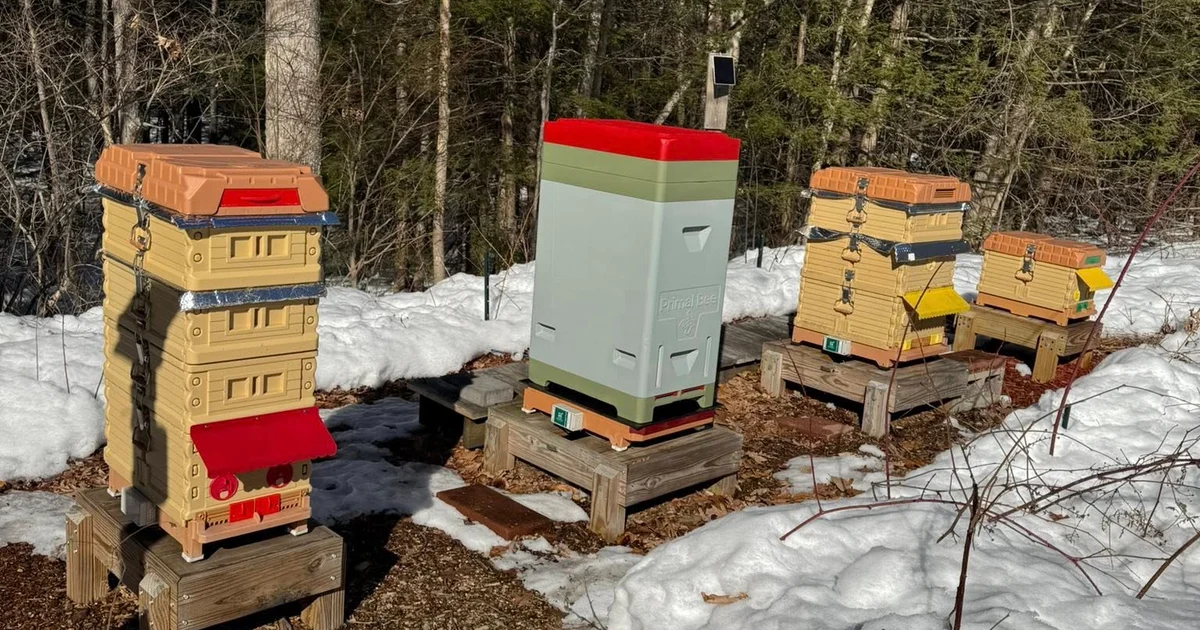
Primal Bee’s monthly live Q&A
We run a live Q&A every month, where a Primal Bee expert takes your beekeeping questions in real time. This month’s topic was winterizing your hive, with Dr. Jason Graham, who learned beekeeping at the University of Delaware and earned his master’s and PhD in Jamie Ellis’s lab at the University of Florida. He’s worked with bumble bees, small hive beetles, solitary bees, and the endangered Hawaiian yellow-faced bee, ran hives at Google and Stanford through the Planet Bee Foundation, and has kept bees for about 20 years.
Here’s the full session:
Prefer the slides? Open the winterizing presentation deck.
When does winter start for your bees?
If your bees have gone quiet at the entrance, check the thermometer. Below about 50°F, honey bees stop flying and settle inside the hive.
On the calendar, meteorological winter starts December 1 and astronomical winter starts December 21. Your bees don’t follow either. Winter follows geography, and it ranges from seven or eight months in Alaska to almost nothing in southern Florida. A Forbes analysis put the average start of the coldest 90 days in the US at November 30, with most regions turning cold between late November and early December.
How long your winter runs decides how much food the colony needs. The standard honey map for wooden Langstroth hives calls for up to two supers of honey in the coldest zone, and less as you move south. That honey is the fuel the bees burn to keep the cluster warm and to start building brood again in spring.
When to do your last fall inspection
A good rule of thumb is late September to mid-October. The better signal is the weather: once daytime temperatures consistently hover between 50 and 60°F, winter is starting.
- Northern and high-elevation climates: aim to finish by late September.
- Moderate climates: mid to late October.
- Southern climates: often into November, as long as days stay at 60°F or warmer.
Open the hive only when it’s 60°F or higher outside, so you don’t chill the bees. Once temperatures drop regularly below 50°F, stop opening the hive. Lifting the lid breaks the propolis seal, lets cold air in, and can break up the cluster and chill the brood.
What to check in a five-minute winter inspection
Keep it brief. Under five minutes is the goal, to limit heat loss. You’re checking four things:
- Honey stores. About 70 to 90 pounds for cold northern winters, or 40 to 60 pounds for moderate climates.
- A laying queen. Look for a good brood pattern, or at least recent eggs or larvae, so you know she’s active and raising winter bees.
- Cluster position. The cluster should sit in the center of the nest box with food stores around the brood.
- Varroa. Do a final mite check and make sure treatments are up to date, so you go into winter with a low mite load.
Our seasonal hive care guide covers the full fall-to-spring sequence.
How to check a hive without opening it
Once it’s too cold to open the hive, you still have ways to see what’s happening:
- Temperature and humidity sensors. ThermoPro makes small sensors for about $10 to $15 each that log temperature and humidity inside the hive. A falling temperature can mean the colony is losing population or running short on food. A rise in humidity is your cue to adjust the varroa tray for more ventilation.
- Hive scales. Broodminder makes temperature, humidity, and weight sensors, including scales that sit under the hive.
- Infrared cameras. These show where heat is escaping and confirm a warm cluster is still inside.
- Endoscopes or borescopes. A small camera you can feed into the hive to look around without opening it.
- The varroa tray. Pull it to look for condensation and debris.
- Flight activity. On days above 50 to 55°F, watch the entrance for bees flying.
Winter setup: bottom board and varroa tray
The varroa tray blocks wind and cold air at the bottom of the hive and helps regulate humidity. Read the tray and the weather, then adjust. You can push it all the way in, leave it partly in, or remove it. If you see a lot of condensation, removing it for a while lets the bottom of the hive air out.
Before it gets cold, clear dead bees and debris off the screened bottom board. Thousands of bees emerge and thousands die every day, and when the bees can’t get out to carry them away, the bodies build up. Our screened bottom board guide walks through tray positions in more detail.
Entrance reducers and snow shelter
In early fall, close one entrance reducer and reduce the other. That cuts robbing and keeps wasps and hornets out. In extreme cold, you can squeeze foam earplugs into some of the reducer holes to shrink the entrance further. Two trade-offs to watch: smaller entrances can raise humidity inside, which you can offset with the varroa tray, and they can slow the bees down when they’re carrying out dead bees. If you use plugs, pull one now and then and check for a backup of bees trying to get out. More in our entrance reducer guide.
In heavy snow country, give the entrance some shelter. Cinder blocks placed in front of the entrance make a small, easy-to-clear shelter and a safe landing zone, so on a warm day the bees can get out for cleansing flights and back in again.
How to configure a Primal Bee hive for winter
The winter stack looks a lot like your initial setup, with one change: slide the follower board all the way against the outside wall.
From the bottom up:
- Nest box, with the follower board against the outer wall.
- Honey super, only if you’re leaving the bees extra honey.
- Feeder lid.
- Empty super.
- Outer cover.
That empty super does two jobs. It sandwiches a layer of air between the feeder lid and the outer cover, which raises the R-value at the top of the hive to about 140. And it lets you check the feeder jar without lifting the feeder lid and disturbing the brood. It’s fine to leave that empty super on all winter, and even year-round.
If your colony only drew out five or six frames this year and there’s a lot of empty space, extra follower boards are sold separately. Place them in the first and eighth frame positions to close the colony in. In some regions, beekeepers use two or three follower boards around a very small cluster, the way some European beekeepers do.
What to feed bees in winter
Jason’s first choice is honey. Leaving honey-bound frames in a super is the simplest backup. One of his Primal Bee hives in Northern California went through last winter with one super on and used only two or three frames of it. He never had to feed, and he knew the food was there if he couldn’t get in.
If your bees didn’t fill a super, or you’re unsure about their stores, use syrup while you still can, then fondant once it’s too cold for liquid feed.
4:1 sugar syrup in a mason jar. Jason uses regular-mouth quart mason jars:
- Fill the jar four-fifths of the way with sugar.
- Add water just off the boil.
- Put the lid on and shake until the sugar dissolves.
- Top the jar back up with more hot water.
Because you top it up, it lands closer to 3:1 than a strict 4:1. That’s still far less water than 1:1, so the bees have less to evaporate before they can store it, and the hive sees fewer humidity spikes. The higher concentration also doesn’t freeze as readily, and in an insulated hive it has to get quite cold before syrup freezes at all. If a cold snap is coming and you can still feed, give syrup now so the bees store it in the nest box close to the brood. We explain the moisture problem with thin syrup in why 1:1 sugar syrup is killing your colonies.
Fondant once it’s too cold for syrup. Making fondant takes a candy thermometer, and you can add a teaspoon of apple cider vinegar. Pre-made fondant works too; Jason mentioned Hive Alive. Rather than laying fondant across the top bars, he prefers feeding it through the feeder hole:
- Pack a regular-mouth quart mason jar with fondant.
- Drill a few holes in the flat lid insert, large enough for bees to pass through, and smooth any sharp edges so they can’t catch a wing.
- Or use a circle of parchment paper with a couple of slits under the ring instead of a drilled insert.
- Invert it over the feeder hole and check it through the empty super. Replace it when it runs low.
Jason calls this method a bit experimental. It’s been tried a few times and works, and the main risk is fondant softening and falling through if it isn’t held in place. Worst case, the bees empty the jar and start building comb in it.
What not to feed in winter.
- Dry sugar, candy boards, and the mountain camp method. Bees have to use water from the hive to dissolve granulated sugar, it’s hard on their mouthparts and digestion, and they often treat it as waste and carry it out. Spilled sugar also draws ants.
- Pollen or protein patties. Protein makes bees need to defecate. In winter, when they can’t fly out, they defecate inside, which builds up pathogens.
If you have to use mountain camp, lay parchment paper with a few slits across the top of the nest frames so crumbs don’t fall through, and watch for ants and for bees dumping the sugar.
Do you need to insulate a Primal Bee hive for winter?
No. Anything you add on the outside won’t make much difference compared with what’s built into the design, and it can cause problems.
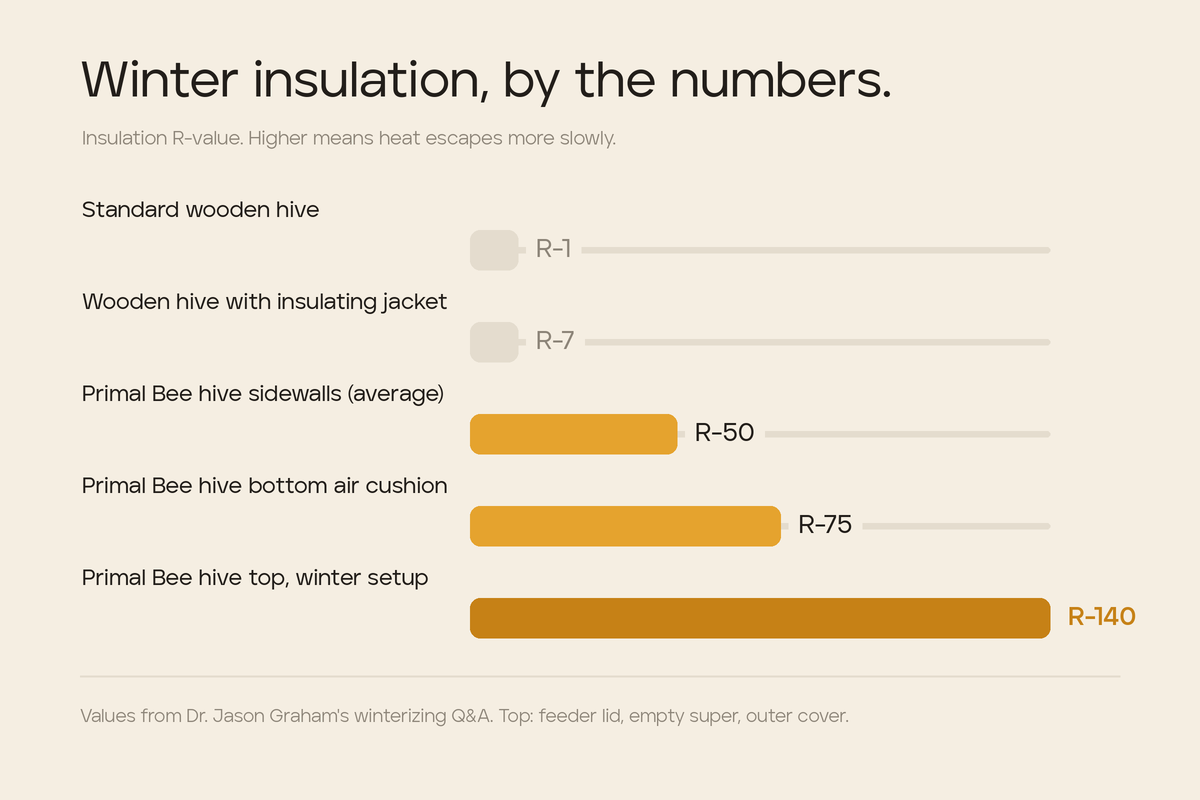
R-value measures how slowly heat moves through a material. A standard wooden hive is about R-1, and an insulating jacket brings it to about R-7. On a Primal Bee hive:
- Top: feeder lid, empty super, and outer cover hold two EPS layers around a pocket of air, reaching about R-140.
- Nest walls: thinner near the top of the frames and thicker toward the bottom, from R-25 to R-75, about R-50 on average.
- Bottom: a 106 mm cushion of still air between the bottom of the nest frames and the screened bottom board gives about R-75.
The jump from R-7 to R-50 doesn’t come from thicker foam alone. The geometry of the hive and the seal between components matter just as much.
That’s also why Jason advises against shims. A wood or other non-EPS shim between the frames and feeder lid becomes the spot where heat leaks out, and any gap lets cold air in. If comb above the frames leaves no room for fondant, feed through the feeder hole instead.
Condensation in insulated hives
This came up from a first-season beekeeper in Northwest Ohio, and it’s a common worry with insulated hives.
The screened bottom board is the answer. On a solid bottom board, condensation runs down the walls, pools on the floor, evaporates back up through the brood, condenses under the lid, and drips onto the brood. Moisture is more deadly to brood than cold. On a Primal Bee hive, water that reaches the bottom drains through ventilation ports, and the cushion of slow-moving air under the frames helps draw moisture out.
Check the varroa tray for standing water. If it’s pooling, open it partway, or pull it, dry it, leave it out for a day or two, and slide it back in.
Some condensation is good. In winter the bees can’t fly out for water, so they collect it from the hive walls. You want a little, not too much, and the hive is designed around that balance.
Winter Q&A highlights
Can I keep honey supers on through a mild winter? Yes, if the bees are using them. A Northern California beekeeper asked this with eucalyptus still blooming. In mild climates where bees still bring in pollen and nectar into November, leave the supers on. If a super sits untouched, take it off so the colony doesn’t have more space than it can care for, and add it back when a flow starts.
Can I leave sugar bricks in the empty super with the plug open? You can, with consequences. Without a direct connection like a mason jar, some bees get lost in the empty super and die there. The bees may also build wonky comb off the outer cover and walls, which you’ll clean up in spring.
I added a pollen patty and found what looked like wax moths. Is that normal? Uneaten pollen, fondant, or sugar can bait wax moths, small hive beetles, and ants, and pollen is especially attractive. Never feed pollen in winter. In good weather, start with a piece about the size of a sticky note instead of a whole patty. If the bees haven’t eaten it within 7 to 14 days, remove it and check it for larvae. Some colonies love patties and others ignore them, even from the same supplier.
There are black powdery spots in my hive. Is it mold? Most likely, and it’s common. Spilled syrup or smeared honey can mold, especially around the feeder rim, and it shows up in wooden hives too. It isn’t harmful to bees or people in small amounts and won’t transfer to your honey. To clean EPS, use a Magic Eraser, or spray a dilute bleach solution of 10 parts water to 1 part bleach.
Some brood frames are cemented in. Leave them or rip them out? If there’s brood on them, leave them and deal with it in spring. A deep dig right before winter does more harm than good. If you need to lift one, take out the follower board first for room, then use the J-hook on the long hive tool to catch a rung of the ladder rail on the nest box sidewall and pull up.
Is nosema a feed problem or a moisture problem? Both. Too much moisture in the hive, or too much water in the syrup like 1:1, means bees take in extra water and need to defecate when they can’t fly out. When they start defecating inside, nosema becomes a problem. Antibiotics can reduce the risk, but the best defense is controlling hive moisture, feeding food that’s easy to digest, and keeping cleansing flights less necessary. See our nosema guide.
Pro tip: weigh the hive now
Get a sense of your hive’s weight before the bees start eating into their honey, by hand or with a hive scale. Then on a later visit you’ll know if it feels light, and you can feed through the feeder hole without opening anything.
For more on why a hands-off fall works, read fall beekeeping management: why less inspection means stronger colonies.
Have a topic you want covered on the next live? Next month we’re going live with our Hives for Heroes partners for Veterans Day. Drop your questions in our Facebook community.
You can also reach Jason directly at jason@primalbee.com, or the team at info@primalbee.com.