
How to harvest honey from a beehive: live Q&A with Dr. Jason Graham
Learn when honey is ready to harvest, how much to leave for winter, and how to extract and store it in this live Q&A with Dr. Jason Graham.
Primal Bee’s monthly live Q&A
We run a live Q&A every month, where a Primal Bee expert takes your beekeeping questions in real time. This was our third, on harvesting honey, with Dr. Jason Graham, who learned beekeeping at the University of Delaware and earned his master’s and PhD in Jamie Ellis’s lab at the University of Florida. He’s worked with bumble bees, small hive beetles, solitary bees, and the endangered Hawaiian yellow-faced bee, ran hives at Google and Stanford through the Planet Bee Foundation, and has kept bees for about 20 years.
Here’s the full session:
Prefer the slides? Open the honey harvesting presentation deck.
When is honey ready to harvest? The 80% capping rule
Before you pull a single frame, one question settles most of the decision: is the honey actually ready?
The answer is written on the comb. When at least 80% of a frame’s surface is capped with wax, the honey is ready to harvest. The bees cap a cell once the moisture content is right, so the wax is their signal that the job is done. Below that, you’re pulling nectar that hasn’t finished curing, and the extra moisture can ferment the honey in the jar.
Two ways to check beyond eyeballing the cappings. Give the frame a firm shake, and if nectar flings out of the open cells, it isn’t ready. For a precise reading, a refractometer should show moisture under 18%. Our when-to-harvest guide covers reading readiness without opening the hive, including tracking super weight over time.
How much honey to leave bees for winter
Harvest is a subtraction problem. Whatever you take, the colony still needs enough to get through winter.
The standard climate-zone charts are built for Langstroth hives, and a Primal Bee hive changes the math, because a well-insulated colony spends far less energy heating itself and burns through less honey over winter. As a rough guide, where a Langstroth chart calls for two deep boxes of honey, one to two deeps is usually plenty here, and you can lean toward the lower end and check partway through winter. In California, one medium left on a hive came through the winter with the bees having used only about two frames of it.
The safer approach for a first winter is to start from the Langstroth number, watch what the colony actually uses, and cut the recommendation next year once you’ve seen it with your own hive.
How to remove honey frames without causing robbing
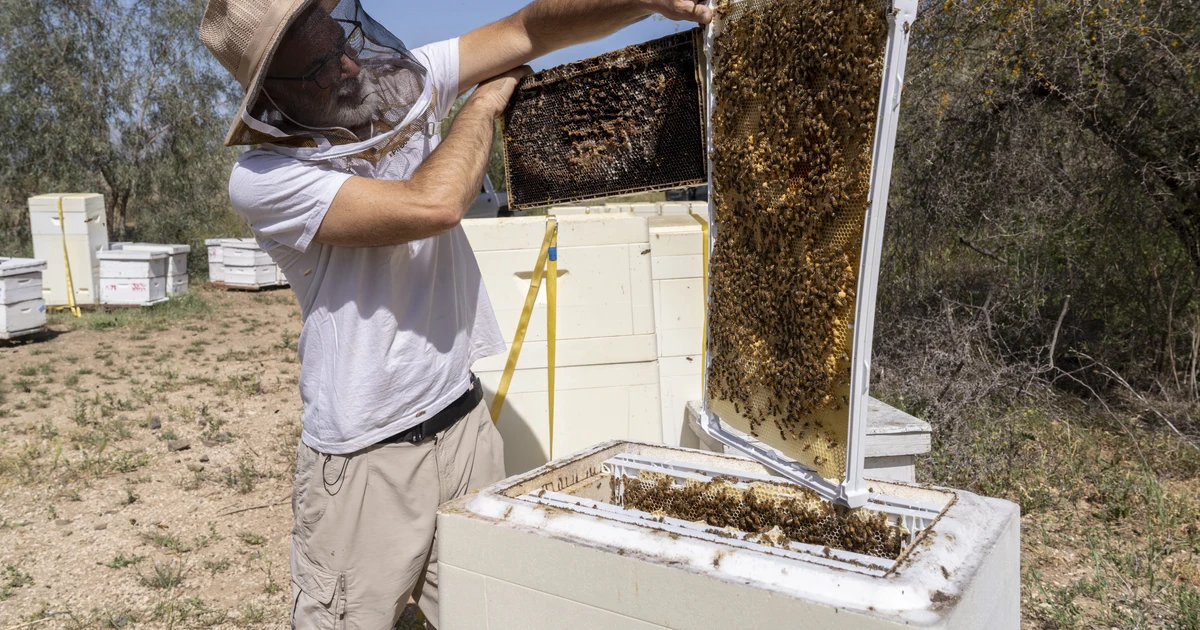
The mechanics of harvest day are simple. Inspect for that 80% capping, shake or brush the bees off, and get the frame out of the area so foragers stop working it, then drop it into a sealed storage bin and replace it with a blank frame so the bees keep drawing comb.
The part that trips people up is robbing, and the fix is distance. Pull your frames at the hive, then physically move them somewhere the bees can’t follow, through a gate, around the side of the house, into a different space, before you open the storage bin. A few bees will sneak in regardless, and you can pick those out later.
For clearing bees out of a full super with less brushing, an escape board fits under the super and lets bees down into the nest but not back up. Left on a couple of days, it thins the crowd, though it never gets all of them and you’ll still brush. Pull the emptied super within a day or two so pests don’t move in. The full sequence, including escape boards and extractor types, is in our clearing and extraction guide.
One hard-won note specific to this hive: glue your supers before they fill. The boxes peg together like Lego and feel solid empty, but a super full of honey is heavy, and an unglued one can pull apart on the lift and drop eight frames on the ground. A drop of carpenter’s wood glue in each peg cavity, left to set overnight, prevents it.
How to extract honey: from frame to jar
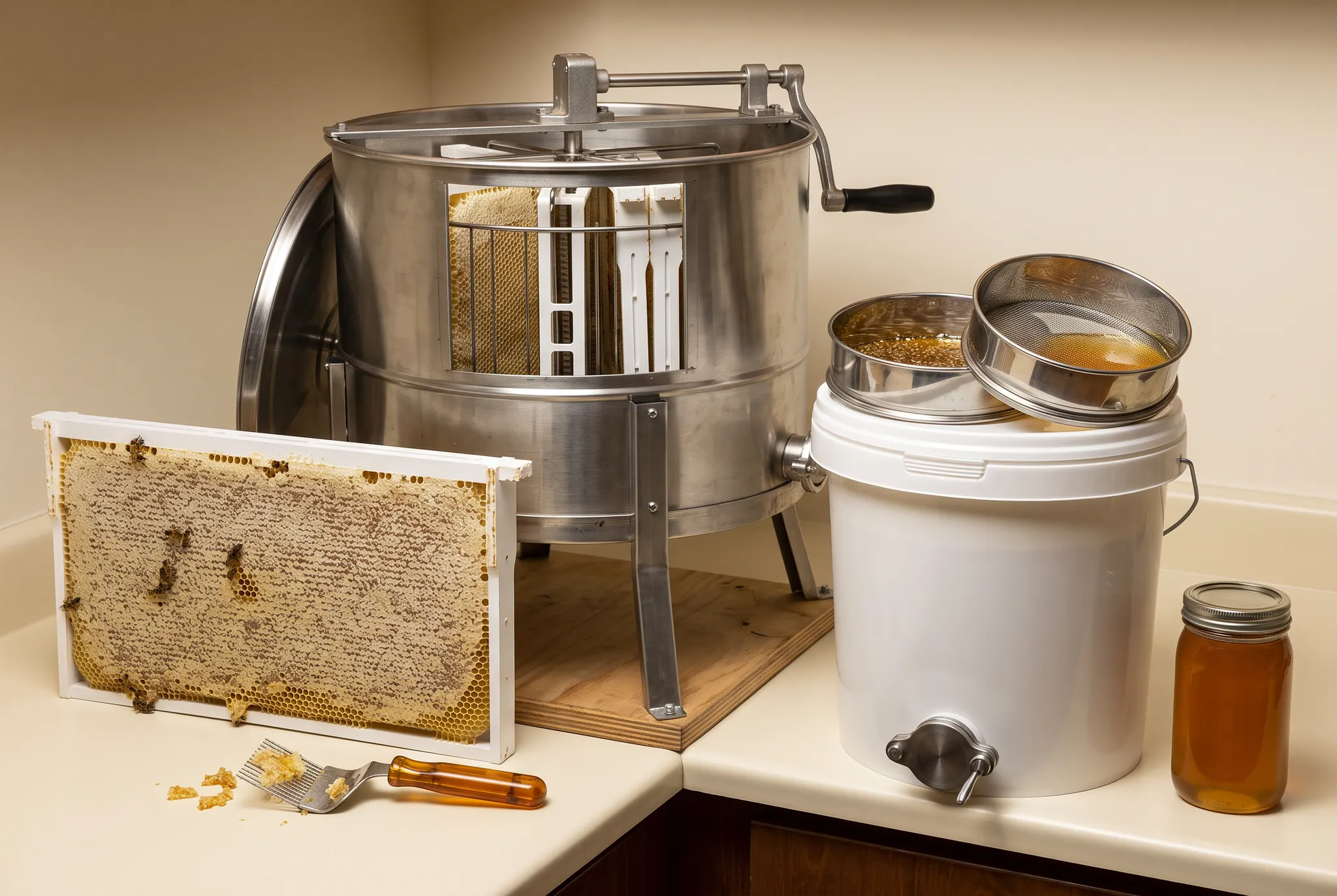
Illustration: a practical frame-to-jar extraction setup.
Extraction is its own project, and it doesn’t have to happen the same day. Frames keep in sealed bins for months, so you can harvest one weekend and extract the next.
When you do it, do it inside, near running water, with food-safe surfaces and a couple of backup plans. Extracting outdoors near an apiary invites every bee and pest in range to come help.
The sequence: uncap both sides of the frame, load a balanced extractor (equal frames across from each other, or an empty frame as a placeholder, or the spin throws off), and spin the honey out. A tangential extractor is cheaper but you flip each frame by hand; a radial does both sides at once. After spinning, let the honey rest in a settling tank at 70 to 80°F for a day or two so the wax floats to the top and lifts off, which saves you a slow, clogged filtering job. Then filter twice, a coarse 600-micron screen for the big wax chunks and a 200 to 400-micron mesh for the polish, and let the bottled jars settle once more so air bubbles rise out.
Bottle into sterile, fully dry jars, leave headspace, and seal tight to lock in aroma and keep ants out.
Wet frames and crystallized honey: what to do
Two questions came up again and again, so they’re worth pulling out.
What do you do with wet frames after extraction? Put them back on the hive if you can time it right. Bees refill drawn comb far faster than they build blank foundation, so wet frames are a fast lane to a refilled super. The catch is robbing: returning wet frames during a dearth, or with the hive open a long time, can set it off. Give yourself a break between pulling and extracting, and another before returning frames, do it fast, and ideally return a whole super at once rather than frame by frame. If timing is bad, freeze the wet frames and give them back later. Freezing 24 to 48 hours also kills wax moth and small hive beetle eggs. Note that the long nest frames never get extracted; those are the bees’ own stores, and you only look at them to gauge how much the colony will have left after you take the supers.
My honey crystallized. Did I do something wrong? The opposite. Crystallization is a sign of pure, unpasteurized honey. Honey that’s been pasteurized or cut with sugar water tends not to crystallize. If yours sets up, warm it in a water bath up to about 100 to 110°F and it clears again. Storing it around 70 to 80°F slows it down. And honey doesn’t spoil, edible honey has been recovered from Egyptian tombs, so a sealed jar keeps almost indefinitely.
Both topics are covered in our storing and processing guide.
How to store honey frames and equipment over winter
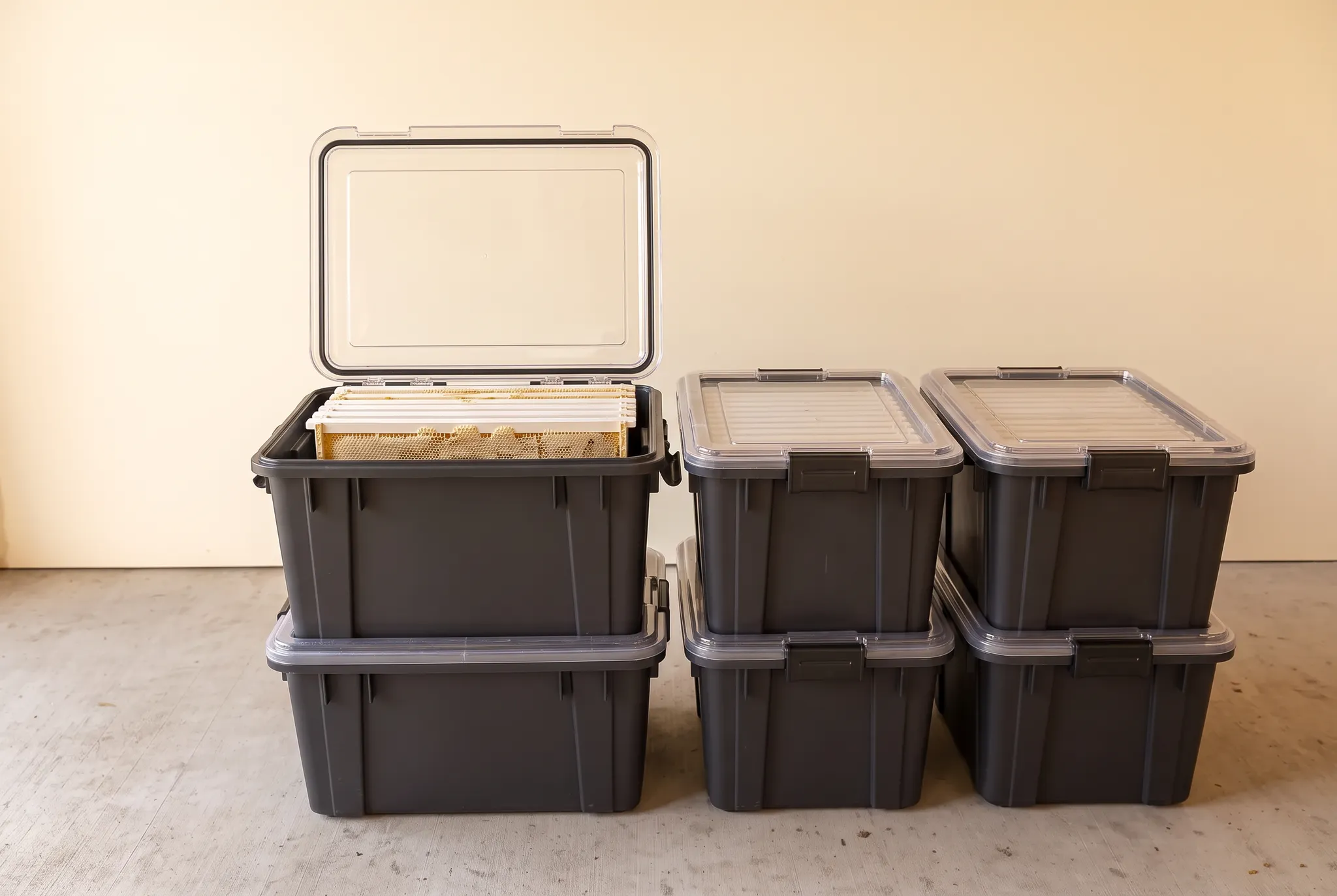
Illustration: sealed, gasketed bins protect dry drawn comb between seasons.
The storage bins do double duty. The same gasketed, dark bins with clear lids that carry full frames to the kitchen also store the drawn comb afterward. They keep ants and light out, let you peek for wax moth webbing without opening them, and quarantine any problem to a single bin instead of your whole shed. Frames have kept in them for the better part of a year with the honey still good.
Larger equipment that won’t fit the bins, nest frames and the like, goes into a double-bag system. Wax moths chew through a single flimsy trash bag, but two layers of the thickest contractor or landscaping bags, each drawstring tied off and the second turned opposite the first, has reliably kept them out. Use unscented bags, store away from mice and ants, and if you’ve already got a wax moth problem, bagging only quarantines it. You still have to clean the equipment and remove the moths.
Honey moisture content: using a refractometer and dehydrating
If a frame is only 70 to 80% capped and you want to harvest anyway, the shake test helps: fling out the loose nectar first so less high-moisture nectar ends up in the final mix. If a bottled sample reads above 18%, you can still bring the moisture down by dehydrating, a warm, dry room with a space heater and a fan circulating air, or a setup like an incubator, will pull the moisture out.
Does smoke affect honey flavor?
Heavy smoking during harvest can carry into the flavor of the honey. Smoke works by masking the alarm pheromone, which smells like artificial banana, so a colony that can’t smell the alarm doesn’t escalate into defense. A couple of puffs at the entrance is usually all you need.
Different fuels leave different notes. Pine straw lends a pine hint; incense can leave something closer to cinnamon. And there’s a bonus fuel worth knowing about: dried stinging nettle in the smoker has shown promise against varroa mites, so your smoke can do double duty.
Selling honey: cottage food laws and labeling rules
If you’re giving honey to friends, none of this applies. If you’re selling it, two things do.
Most states have a cottage food law that lets you sell homemade honey from a home kitchen without a commercial setup, because raw honey is shelf-stable and low-risk. The specifics vary a lot: the sales cap ranges from around $10,000 in some states up to $250,000 in Florida, and most require a basic food-safety course and a permit. Labeling rules are stricter for sales, exact physical processing address (no PO box), net weight, producer contact, the word “honey” displayed plainly, any infusions named, and some states require you to grade the honey or mark it spring or fall.
Scaling and the regulatory side are covered in our scaling guide, and cottage food laws differ enough state to state that it’s worth confirming your own before you sell.
What to do with beeswax cappings after harvest
Wax is, by weight, more energetically expensive for bees to produce than honey, so it’s worth saving rather than tossing. Melt cappings down in a solar melter, or a metal pitcher inside a pot of boiling water as a double boiler, and pour into silicone molds. Wax is flammable and will ignite at high enough heat, so watch the temperature. From there it becomes candles, balms, furniture polish, foundation for next season, or a natural wound cover. The marketable-products side, wax, propolis, and pollen, is covered in our hive products guide.
Two pro tips from the Q&A
Pro tip: get your honey judged. You can send a sample to a lab for a purity test, or even a spectroscopy “fingerprint” that maps the pollen and flavor composition of your specific honey. You can also enter honey contests, including blackjar competitions where the jar is painted so judges taste blind. A placement is a real marketing asset when you go to sell. There’s a certification path too: the book The Honey Connoisseur and its author’s sensory course can take you toward becoming a certified honey taster or judge, which comes with invitations to taste honey around the world.
Pro tip: the 130-pound winter check. One benchmark out of Iowa: lift or weigh the whole hive going into winter. Around 130 pounds means the colony has enough stores and you won’t need to feed. Below that, be ready to add honey or feed later in the season. A Bluetooth hive scale lets you track the weight trend all winter and tells you the moment stores are running low.
Can you harvest honey in your first year?
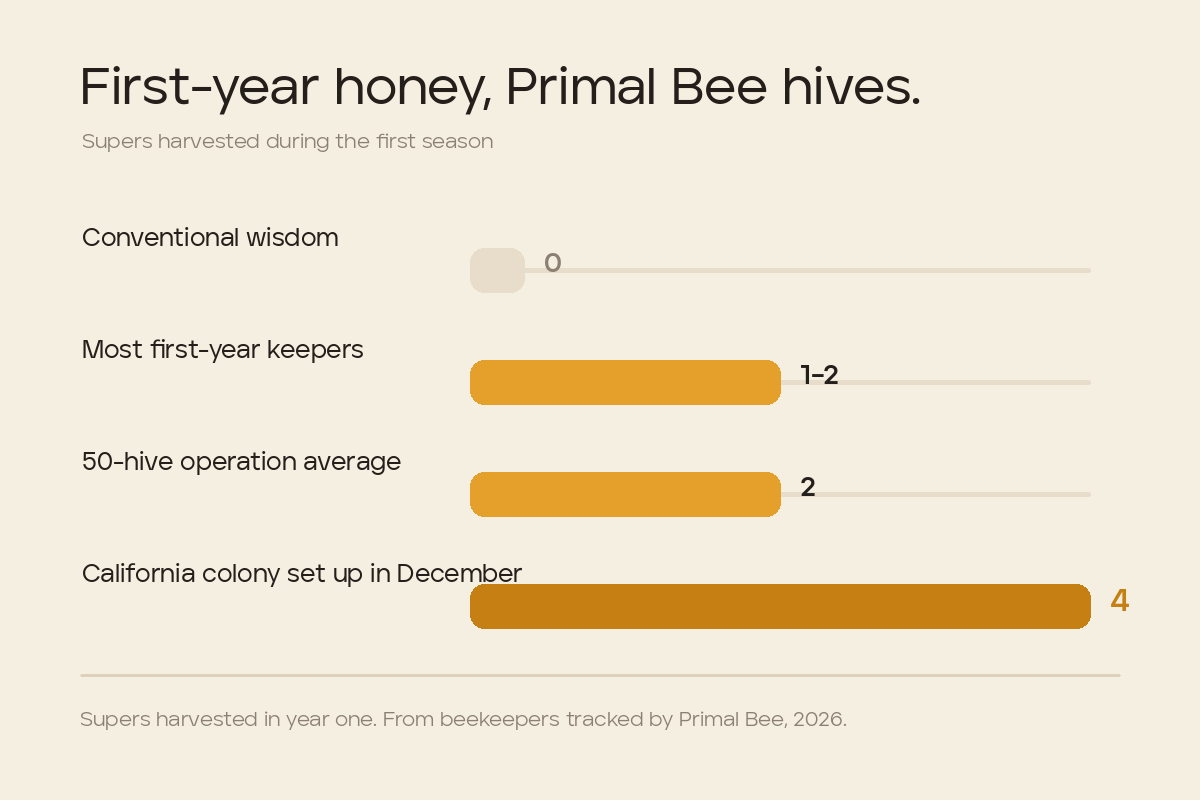
For about twenty years, the rule of thumb has been simple: a hive started this year gives you no honey until next year. The colony has to build comb, raise bees, and store enough to overwinter before there’s any surplus to take.
That rule is bending on the Primal Bee hive. A California colony set up in December ran the whole following year and produced four supers of honey, unheard of for a first year. It isn’t a fluke, either. Most first-year keepers being tracked are pulling one or two supers, some three or four, and one operation with 50 hives averaged about two supers each in year one.
The reason ties back to energy. A colony that isn’t spending itself clustering, vibrating, and hauling water to cool the hive through a heat wave has that energy free for foraging and storing. Long frames keep the population continuous and large, so more foragers bring in more food while the colony spends less of it on climate control. The honey builds up fast.
The old advice isn’t wrong so much as it was written for hives that make bees fight their environment. Take that fight away, and the first-year ceiling moves.
Have a topic you want covered on the next live? We run these monthly, on the third Wednesday. Drop your question in our Facebook community.
You can also reach Jason directly at jason@primalbee.com.