A global tour for World Bee Day
The 2026 FAO theme for World Bee Day, Bee Together for People and the Planet: a partnership that sustains us all, asks us to think about the working relationship between humans and bees across cultures and climates and scales: honey hunters in forests, commercial queen breeders, school teachers running classroom hives, floodplain beekeepers in Nepal, traditional knowledge and modern engineering both, women and youth especially.
What it captures, when you sit with it, is that the partnership between people and bees has never been one thing. It's a third-generation queen breeder in Northern California, fighting a honey market that has been broken for half a decade. It's an Air Force military spouse in Texas teaching middle-schoolers to recognize trophallaxis. It's two Italian childhood friends who spent three winters losing everything in the Alps before they ever built the hive that would become Primal Bee. It's a Ukrainian-born beekeeper in the Negev Desert running an apiary that doesn't need to be treated for Varroa. It's a Canadian engineer designing hives that float up off the ground when the floods come. And it's a Slovenian PhD who spent three years quietly walking a proposal through the UN until May 20 was declared World Bee Day in the first place.
So for World Bee Day this year, we profiled all of them.
Six beekeepers, six landscapes, six completely different ways of holding up the human end of the partnership.
Ryan Sparks Burris: a third-generation queen breeder in Northern California

Ryan Burris went to law school and practiced in Las Vegas before he came home to keep bees. "It was always in the back of my head," he told us. "I was just super unhappy not being a beekeeper. This is in my blood. It's what I was meant to do."
His family has been breeding queens in Northern California since the 1940s, and Ryan runs Park Legacy Queens out of Palo Cedro, just east of Redding, where he also serves as President of the California State Beekeepers Association. The name on the door is his mother's maiden name, the side of the family he grew up closest to, and on a peak day in April his crew will catch eight hundred queens, pack them, and have them on a UPS truck by 3 PM. He still builds his own wax cell cups by hand, which almost nobody does anymore, and he compares himself to a winemaker when he's trying to explain why. "You can be a Gallo and make tons and tons of cheap wine, or you can be a Stag's Leap and focus on quality. My name means a lot to me. My family name means a lot to me."
That orientation, quality over volume, lineage over shortcut, runs through how he works with the bees themselves. He handles his colonies in jeans and a homemade veil, no full suit, because as long as he's gentle and treats them with some respect, he doesn't ever fret about getting stung.
The almond bloom this year was one of the quickest anyone could remember. As Capital Press noted earlier this season, the California almond pollination season is the largest commercial pollination event on Earth, taking roughly 2.5 million colonies to cover more than a million acres of orchards every year, with 1.8 to 2 million of those hives trucked in from outside the state.
"This year's bloom started, and it was almost done in two weeks," Ryan told us. "It seemed like all the varieties were blooming at the exact same time. Which was very unique." Pollination happened anyway, but bee counts were down again, the way they've been down every year now, and the Pacific Northwest is heading into another season that needs more rain than it's getting.
What worries him more than the weather is what's happening to the price of honey. A single load of syrup runs $20,000 to $27,000 right now, depending on where you are in the country, and the bigger commercial outfits go through one of those every week. Meanwhile the wholesale price US beekeepers get for honey has been stuck near $1.27 to $2.00 a pound for half a decade, often below the cost of production, while foreign honey enters the market for as low as $0.80 a pound and gets blended into product labeled "USA grade." What Ryan wants isn't a subsidy, it's accurate labeling: "If you put honey in the store, and you say it's USA grade A, it better be a hundred percent USA grade A honey."
Then there's the theft, which California is the worst region in the country for, and the math of it is brutal. CSBA data put 2024 losses at a record 3,492 stolen colonies and an estimated $1.2 million in damages to California beekeepers, and a stolen hive at almond peak is worth, in Ryan's words, "more like losing a pet than losing equipment," because every hive in his yard has been built up across years of feeding and care that no insurance check can replace. This February, 172 hives stolen from a Merced County orchard on February 6 were recovered and returned to their owner, Teresa Breshears of Washington state, within twelve hours of discovery, after CSBA Vice President Trevor Tauzer identified the colonies on private property in northeastern Yolo County and Sgt. Matt Wirick of the Yolo County Sheriff's Office coordinated the arrest of a suspect within four hours. The recovery was one of the fastest Ryan has ever seen, though about a thousand hives stolen this season are still gone.
What he wished the public actually understood about beekeeping wasn't save the bees. It was:
"Endure the suck."
A sting, he says, is nothing. It lasts seconds. What lasts is the blood, sweat, and tears of staying determined enough to keep the operation going, to feed your family, pay your mortgage, and make sure your employees are well compensated. It has only gotten harder in the last twenty years, nothing has become easier, and the people still in it are still in it on purpose.
What he is optimistic about isn't the weather or the prices, it's the people. CSBA has partnered with the American Honey Producers Association and the American Beekeeping Federation, along with a growing number of state organizations, to push together for honest USA honey labeling, and this November the two organizations will host their annual conventions jointly in Reno, November 16 through 19. It's the first time the California state organization and a national organization have met.
"AHPA is a great organization that campaigns for fixes on these honey issues, so we're really excited to work with them as a team," Ryan said. "Joining together to fight for the same issues rather than competing with different voices, making sure that we have the same message going forward."
Emily Hartley: bringing bees into a Texas classroom

Emily Hartley started keeping bees five years ago, but she didn't start as a hobbyist. Her husband was retiring from the AirForce, she knew she wanted to do something next, and after an online workshop left her sitting in front of a lot of bee vocabulary she didn't recognize, she enrolled in the University of Montana's beekeeping program and worked her way through every certification it offered. The master's class is coming up. She hasn't looked back.
Some of it, she figures, goes back further than five years anyway. She was raised in a log cabin in Oregon with cherry orchards and hives in the yard, and the bees had been there in the background of her childhood without her thinking much about them. When she went looking for what was next, it turned out they had been waiting.
What she does now is run a beekeeping program at Marvelously Made School, a K-through-8 school in Helotes, Texas, on a volunteer basis. She started two years ago on a small patch of land in front of the school, planted flowers, set up a Langstroth hive, and began building lesson plans. Last year she put together a proposal to switch the school's equipment to Primal Bee, the proposal was accepted, and the kids now have two hives, one for the younger grades and one for the older ones.
The program runs the full arc of a season. The kids keep bee journals, they make candles when there's wax to render, they harvest honey for themselves and for the staff, and the older students are about to start helping with sugar syrup and hive inspections. Emily has them on a safety-first progression, building from observation to participation across multiple terms, and the next milestone is putting suits on the older kids and opening hives together. What surprises her, when she talks about it, is how completely the kids hold still.
"It's amazing how involved they are with the bees and how much they wanna know," she told us. "When I teach, they're completely absorbed for like an hour, and that's incredible. They're not waiting for me to finish."
There's a particular pattern she's watching for, which is fear flipping into curiosity. Some of the kids come in nervous about insects, some of them have a beehive at home they've never engaged with, and the program is built to move them through that and out the other side. One girl whose family kept hives at the house arrived not liking them at all, and by the end she was outside with her parents, working the bees, wanting to be there. "My goal is to turn that into wonderment," Emily said. "To change that fear for them into really wanting to become engaged with the beekeeping and own it, and start to learn how to become a beekeeper themselves."
She also teaches native bees alongside honey bees, which most school programs don't, and a few of the older students have become invested enough that they don't want to break for summer. Some of them are graduating this year, which she finds bittersweet as they've developed a real community over the last few months.
The next build-out is an observation hive for the youngest students, who can't safely suit up and stand in front of an active colony, and the plan is to take the school's smallest Primal Bee hive, the cottage hive, and modify it so the bees enter and exit through a tube that runs through the classroom wall. The colony will live inside the classroom, the bees will fly free outside, and the kindergartners will watch comb-building through the glass with magnifying glasses in hand.
What she finds most rewarding about all of it isn't the bees, it's the teaching. "For me, that is the most rewarding piece of beekeeping. Being able to share that knowledge with the kids, and knowing that if we don't teach them to care, they're not going to care."
Alex and Gianmario: three winters of failure in the Italian Alps
Alex and Gianmario started keeping bees in the foothills of the Italian Alps in October 2005, and for three years straight they lost everything they put into it.
"We never got a drop of honey, and we never survived the winter with our colonies," Alex told us. "Three years in a row."
They were childhood friends who had run a machine tool company together, mountaineers on weekends, and hobbyist beekeepers in whatever time was left. In the fourth year, working with what they called the first prototype, a hive Gianmario had begun engineering after concluding that the Langstroth box wasn't actually built for the bees, they overwintered successfully for the first time, and from that prototype, eventually, came Primal Bee.
What kept Alex going through those failure years wasn't stubbornness so much as a particular kind of attention. He talks about the bees the way somebody might talk about a small child whose moods you've learned to read, and he gets to a moment in the season he can describe more precisely than anything else in his life.
"You go to the apiary, and Gianmario and I are very sensible. We don't want them to lose energy. With an iron tool, you lift the mass cover just a couple of centimeters to look through. There is a phenomenon that the bees do when they are ready, when they ask you to put some supers on. The top beam of the nest frames, they start building brand new, the very beginning of brand new combs, and that beeswax is pure white. So in Lombardy, we say in Yankaro, which can be translated as painting. When they are painting, you can put two or three supers on. That's the real moment when you can really say, okay, in the last twelve months, I did a good job."
What he's describing isn't a yield, but a signal from the bees that they have enough room, and enough confidence in the season, to expand, and Alex's whole way of measuring success runs through it.

Vanya: beekeeping in the Negev Desert
Vanya emigrated from Ukraine to Israel in the 1990s and met Alex and Gianmario more than a decade ago, well before Primal Bee existed as a company. Once they shared the technical specs of what they were building, Vanya constructed his own prototypes from the drawings and started keeping bees in them in the Negev Desert, where summer temperatures regularly clear 40°C and the question of how a colony survives is reversed from everything the Italian prototype was designed for.

Cooling a hive, as it turns out, costs the colony as much energy as heating one, and the same high-density EPS shell that retains heat in winter prevents overheating in summer. So Gianmario's engineering, which had been built to survive an alpine winter, was also, by accident or by physics, the right answer for a desert.
What's notable about Vanya's apiary, though, isn't only the climate. It's that he doesn't treat for Varroa. For him, in his words to Alex, Varroa is not a problem. That sentence will set off alarms for most American beekeepers, and rightly so. Untreated colonies in most North American apiaries collapse within a year or a year and a half, and before Vanya started building Primal Bee prototypes, his colonies in standard Langstroth equipment behaved the same way: a year and a half, maybe two, and then everything down. In the prototypes, in the desert, with no treatment at all, his colonies have been performing at top level for years.
This is one beekeeper in one extreme climate, not a generalizable recipe, and mites remain the number-one killer of US colonies. What Vanya's apiary does suggest is that the housing matters more than American convention assumes. When a colony isn't burning energy fighting the heat or the cold, the resources left over for everything else, comb building, brood rearing, immune response, go further. In the Negev, with Primal Bee equipment, far enough.
Konrad Borowski: hives that float when the floods come
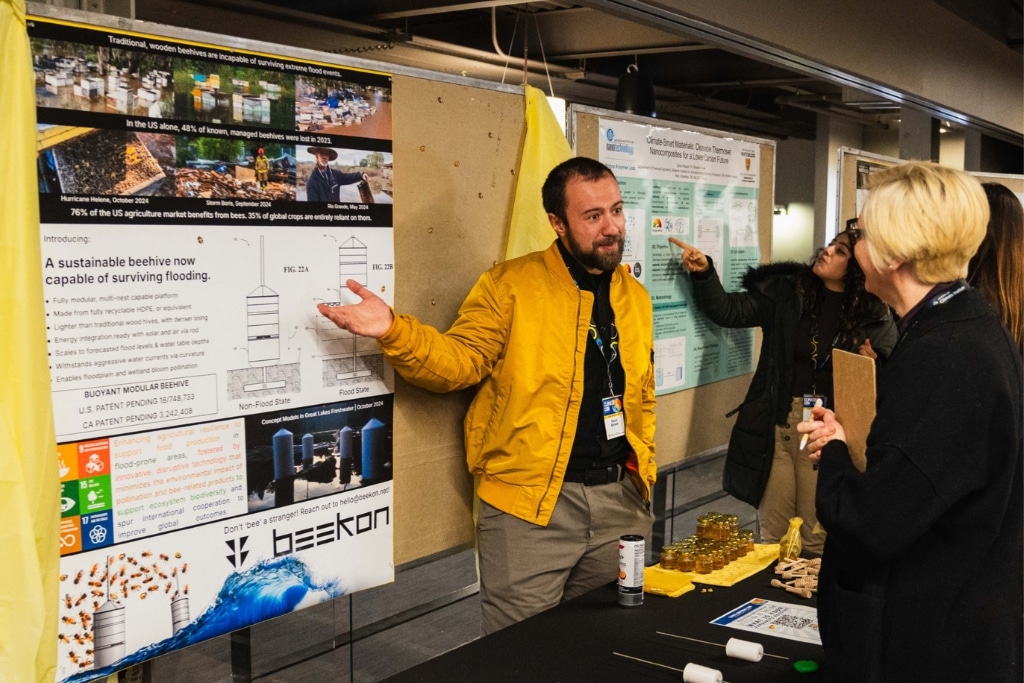 In 2023, Konrad Borowski was watching a documentary with his mother when a story stopped him. A beekeeper in the Philippines had lost two hundred hives overnight to flooding, and the damage rippled out through the community, because the surrounding farms depended on those colonies for pollination.
Borowski has a background in mechanical and systems design, and a week after that documentary he had a first computer-aided draft of a prototype. From that draft came Beekon, a buoyant modular hive made from recycled plastic, wrapped around a central mast anchored to the ground. When water rises, the hive floats up. When the water recedes, it settles back down. After installation, no human intervention is required.
"The stationary wooden beehive has been the standard model for more than 200 years," Borowski told Earth.Org. "Unfortunately, that standard is no longer capable of withstanding many of the environmental stressors we see today. Most beekeeping happens near agriculture, and most agriculture happens near open bodies of water. As a result, we are facing the potential loss of pollination services to entire ecosystems in a matter of moments."
His first large-scale pilot was planned in Malawi and got put on hold after USAID was shuttered earlier in 2025, and his next is in the works in Nepal, where the September 2024 floods killed 236 people and disrupted entire agricultural regions. What he keeps coming back to, more than the engineering, is how he frames the relationship itself.
"There's this predominant idea, maybe misconception, that pollination just sort of happens. But it's ultimately a service. And like any service, water, power, waste management, it depends on reliable infrastructure."
Dr. Peter Kozmus: the diplomat who got the UN to recognize bees
 World Bee Day exists because of Peter Kozmus.
Kozmus is a Slovenian beekeeper who has been working hives since 1994 and serves today as Vice President of Apimondia, the International Federation of Beekeepers' Associations, founded in 1895. He's also the professional leader of the breeding program for the Carniolan honey bee at the Slovenian Beekeepers' Association, head of the Council for beekeeping at Slovenia's Ministry of Agriculture, and what Transitions magazine has accurately described as "a bee diplomat," advocating for pollinators at home and abroad. He has a PhD. He has been Secretary-General of an Apimondia Congress. He has presented Slovenian beekeeping initiatives in Austria, Croatia, Serbia, France, India, Ireland, Argentina, Ukraine, and South Korea.
Slovenia is, by any reasonable measure, the most beekeeping-saturated country in Europe. Two million inhabitants, more than eleven thousand beekeepers, the highest per-capita rate on the continent. A third of primary schools have beekeeping clubs. The Carniolan honey bee, native to the country, is the second-most-kept honey bee subspecies in the world after the Italian. Beekeeping is woven into the school curriculum, into the national identity, into the food economy, and into the diplomatic posture.
Out of that context, in 2014, Slovenia began three years of advocacy through the UN General Assembly to formally recognize the role of bees in global food systems. The proposal, drafted by the Slovenian Beekeepers' Association and championed by the Republic of Slovenia, was unanimously adopted in December 2017. May 20 was chosen because it was the birthday of Anton Janša, the eighteenth-century Slovenian beekeeper who became one of the first formal teachers of apiculture in Europe. Kozmus was, throughout all of it, the working figure shepherding the proposal through.
What he wanted out of it was practical, not ceremonial.
"Beekeepers have the problem that the environment is changing in ways that aren't friendly to bees and other pollinators," he told Transitions. "We can solve some of these problems ourselves, but for others we need help, and a World Bee Day seemed like the best opportunity and tool to get that."
In the years since, he has used the platform to push on the issues most beekeepers don't have the standing to push on alone. Honey fraud, in particular. As Vice President of Apimondia, he has been one of the strongest international voices for stricter authenticity standards on global honey, the same fight Ryan Burris is making at the state level in California. He has helped lead efforts to establish a global certification regime for beekeeping tourism. He has worked, country by country, to bring small-population beekeeping nations into the same conversation as the commercial-scale operations of the US, Argentina, and China.
This year's Third International Forum for Action on Sustainable Beekeeping and Pollination, which the FAO is co-hosting with Slovenia in Maribor on May 20 and 21, is the institutional descendant of the work Kozmus has been doing for two decades. The forum's stated theme, Science, innovation and policy actions for a more sustainable future, is, broadly speaking, his sentence. If you're following along with World Bee Day from anywhere in the world today, the broadcast is happening because of him.
More partnerships, in our own backyard
Six profiles can't carry the whole picture. Here are three more we've published or are publishing this season.

Julia Mahood has been teaching beekeeping at Arrendale State Prison in Georgia for over a decade, and her students, mostly women, are passing journeyman and master beekeeper certification exams that have an 80% fail rate on the outside. "We don't have anything else to do in here but study," one of them told her after her first class. "On the outside, people are distracted by their lives." For incarcerated women, many with histories of trauma, the combination of nature, caretaking, and cooperative work fills a need most prison programming doesn't touch. We profiled Julia, along with six other women shaping beekeeping today, in our International Women's Day roundup earlier this year, alongside Eva Crane (the British nuclear physicist who spent six decades documenting bee nests across 60 countries), Marla Spivak (whose Minnesota Hygienic line changed how American beekeepers think about disease resistance), Jasmine Joy (Beelieve Hawaii), Raylynn White (Beehaven, 60,000 members strong from Newfoundland), Nichole Danova (Modern Beekeeper, a Primal Bee retailer since the company's earliest days), and Katie Metzger (Hānai Hives on the North Shore of Oahu, who makes it possible to keep bees without a backyard).

Gosia has been keeping bees for eighteen years across sixty colonies and five locations in northern Poland with her husband, raising queens, running traditional Wielkopolski hives, and practicing uloterapia, an Eastern European tradition in which people breathe the bioactive air from inside a colony for its therapeutic properties. This spring she added a Primal Bee hive to the operation, and in one of the worst seasons her region has seen, cold and rainy, her colony was flying at 8 to 9°C while neighboring colonies stayed clustered, consuming roughly a third less feed than her traditional hives, and superseding their own queen successfully without losing population strength. "Now I know I can easily carry out inspections in Primal Bee hive with very little effort," she told us. We published her full story this fall.

Dr. Adam Ingrao runs Heroes to Hives, the largest agricultural training program for veterans in the United States, out of Michigan State University Extension. A former soldier who came home from the Army in the early 2000s into the opioid epidemic, he found his way to bees through an undergraduate elective at Cal Poly and started Heroes to Hives in 2014 out of his living room in Lansing. The first cohort was five veterans. The program is now in its eleventh year, reaches roughly five thousand new enrollees annually, and has cumulatively served close to twenty thousand veterans. "It just completely changed my life," he told us about that first beekeeping class. "It was the first time, since I was in the military, where I was like, wow, this is the first time I actually feel like I could serve my country again, by protecting pollinators." In 2024, the Therapeutic Recreation Journal published the first peer-reviewed study of beekeeping as a clinical intervention for veterans, co-authored by Ingrao. The findings: a 31% session-over-session improvement in anxiety and depression scores among veterans at the Manchester VA Medical Center. We're publishing a full guide to Heroes to Hives, Hives for Heroes, VA HIVES, UMN Bee Veterans, and Bee Heroes America later this month. Sign up to be notified →
How to mark World Bee Day this year
The FAO's central event is in Maribor, Slovenia, on May 20 and 21, where the Third International Forum for Action on Sustainable Beekeeping and Pollination will be webcast in English at fao.org/world-bee-day, and a second in-person celebration runs at the Palais des Nations in Geneva on May 27.
If you're a beekeeper, the most useful thing you can do this week is the work you were already going to do, which is to say: inspect a hive, check stores, talk to a neighbor who's getting started, send this piece to a teacher you know.